Addiction Commonality

Alcohol, Opiates, Fat and Sugar are all Addictive Substances: this blog is about that "addiction sameness".

Butter Pig Family

* A butter sculpture of a sow and her piglets

Sunday, April 12, 2015

California Drought


Embedded image permalink

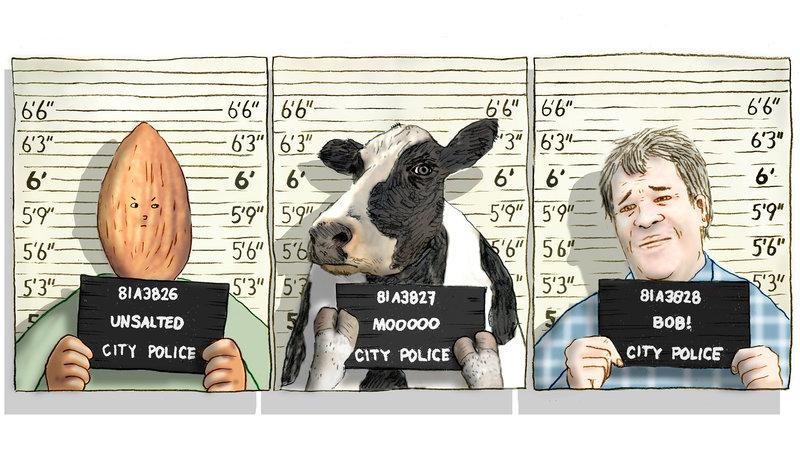
Almonds?
Cows?

Who's the worst water guzzler in California's 

drought? 

We round up suspects:


Source: http://www.npr.org/blogs/thesalt/2015/04/12/398757250/beyond-almonds-a-rogues-gallery-of-guzzlers-in-californias-drought

NPRFood
@NPRFood

The Twitter home of NPR's James Beard Award winning food blog, The Salt, plus links to all of NPR's other food coverage.
Washington, DC
npr.org/blogs/thesalt

 Almonds: A Rogue's Gallery of Guzzlers In California's Drought


APRIL 12, 2015


DAN CHARLES

Twitter

Listen to the Story
Weekend Edition Sunday


4 min 25 sec
Playlist
Download
Transcript


Leif Parsons for NPR


California is parched. Wells are running dry. Vegetable fields have been left fallow and lawns are dying. There must be some villain behind all this, right?


Of course there is. In fact, have your pick. As a public service, The Salt is bringing you several of the leading candidates. They have been nominated by widely respected national publications and interest groups.


There's just one problem: Not all of these shady characters live up to their nefarious job description. Let us explain.


1. Almonds


Both Slate and Mother Jones have reported that almonds are sucking California dry. Each innocent-looking nut, we learn, robs the land of an entire gallon of water. All told, California's almonds consume three times more water than the entire city of Los Angeles. And their thirst is growing, year by year. California's farmers continue to convert new swaths of land to almond orchards.


Case closed? Maybe not, Grist retorts. Almonds get a lot of attention because production of them has been booming. And it's true that they do consume more water, per acre, than many other crops (though not all). Vineyards use much less water than almonds, and most vegetables also require less irrigation.


But that's only if you calculate water use in gallons per acre or gallons per pound of product. There's a different, and probably better, way to calculate water efficiency. How about water consumption per unit of value created? Gallons used per dollar of production, say. By that measure, almonds look just great, because they are so valuable.


So there's a very good argument that almonds are exactly what California's farmers should be growing with their precious water.


There is one problem with almonds, though. They're trees. They last for years, and they need water every single year, whether it's wet or dry. Farmers who've devoted their land to production of almonds (or walnuts and pistachios) can't easily adapt to water shortages. Letting the trees die would be a catastrophe, so they sometimes pay exorbitant prices or dig ever-deeper wells.


Water experts like Jay Lund, from the University of California, Davis, say that in the future, California should take care to maintain a healthy mix of trees and annual crops like vegetables. In drought years, farmers could then decide not to plant their tomato fields, freeing up water for their trees.


2. Cows


If you look at this presentation by Blaine Hanson, an irrigation expert also of UC-Davis, one thing jumps out. The agricultural product that truly dominates water use in California isn't almonds. It's alfalfa, plus "other forages," such as irrigated pasture and corn that's chopped into a cattle feed called silage. These forage crops consume more water per acre than almonds, and they also cover nearly twice as much land.


And where do those products go? Primarily, they feed California's enormous (though shrinking) herd of milk-producing cows.


Unlike almonds, forage crops don't bring particularly high prices. And they grow just fine in other places, too, such as the Midwest. So why should California sink its scarce water into such crops? It mainly results from the long tradition of dairy farming in the state.


But abandoning milk production would entail considerable economicdislocation. Also, these crops have remained viable because many farmers are guaranteed ample supplies of cheap water. Those in the Imperial Valley, a major alfalfa producer, get water from the Colorado River. Which leads us to ...


3. Laws and the politicians who make them.


Where to start? With the founding of the republic, maybe. When Europeans and other outsiders settled this continent, they operated under the basic rule of first-come, first-served. People who settled land got to claim it. And in much of the West, if they built a dam to irrigate their fields, they acquired a permanent legal right to that water. There were very few questions asked about how that water should be used, or what it should cost.


That basic idea remains in force, although the system for delivering water has been transformed by large, government-financed networks of aqueducts and canals. And hidden inside this legal framework are several characters that arouse strong suspicions.


4. Cheap water


For the most part, farmers don't have to outbid anyone for their water. They get it, or they don't, depending on the priority of their legal claim to it. Typically, they get that water for the cost of delivering it. This means that they don't have a pressing need to conserve that water, for instance, by switching into crops that make better, more economic, use of the water.


A limited market for water is now developing, which sets higher prices on water. It's driving farmers to treat their irrigation water more like the precious commodity that it really is.


5. Free water


This is the water that farmers pump from wells on their land. It's not exactly free, because it costs money to drill the well and pump the water, but farmers are legally free to use as much as they wish.


As a result, farmers have been racing to empty their aquifers, draining the water in them at an astounding rate. California has now adopted a plan which is supposed to eventually stop this, but it won't fully take effect for many years.


6. Fish


These are the villains of choice in parts of California's agricultural community. California's environmental authorities have stepped into the water allocation game, asserting that the state's endangered wildlife have rights to water that trump the claims even of the earliest settlers. As a result, in drought years, farms are getting less water — much less, in many cases, than state authorities originally promised to deliver. This is why some farmers complain, passionately, about a "man-made drought."


7. Exports


According to some reports, California's farmers are exporting vast amounts of water to places like China, adding to the state's water shortage. These are not literal water exports, but "virtual water" in products like alfalfa or almonds that took a lot of water to produce. Upon closer examination, though, this villain doesn't look quite so guilty. As Lund from UC Davis points out, alfalfa and almonds are the exceptions to the rule. If one counts all agricultural commodities, California imports far more virtual water than it exports. Its imports of corn, meat, lumber and cotton all required huge amounts of water.


Okay, time to pick one. Who's your drought-provoking villain of choice?


Friday, April 10, 2015

Sugar, Salt, Fat

Salt, Sugar, Fat


Michael Moss is the author


of the #1 New York Times bestseller SALT SUGAR FAT, winner of the 2014 James Beard Foundation Book Award for Writing & Literature, and a Pulitzer Prize-winning investigative reporter formerly with the New York Times. His writing focuses on the food industry in context of health, safety, nutrition, politics, marketing, corporate interests, and, finally, the power of individuals to gain control of what and how they eat. He has been a reporter at The Wall Street Journal and an adjunct professor at the Columbia School of Journalism. He continues to report on the processed food industry and is currently at work on HOOKED: Food and Free Will to be published by Random House.Salt, Sugar, FatHow the Food Giants Hooked UsBy Moss, MichaelBook - 2013


Michael Moss
@MichaelMossC


Official account of the Pulitzer Prize winning journalist & author of the #1 New York Times bestseller #SaltSugFat. RTs & link shares ≠ endorsements.

The origins of the word ‘˜marijuana’ in the US

 marijuana


Marijuana grower Joe Rey feeds plants a combination of nutrients and molasses in a flower room at 3-D, Denver’s Discreet Dispensary, Dec. 4, 2013.
Craig F. Walker / The Denver Post via Getty Images


Weed all about it: The origins of the word ‘˜marijuana’ in the US


by Alfonso Serrano @serfer6 December 14, 2013 2:59PM ET


How did the drug, once commonly known in the U.S. by its scientific name, cannabis, come to be called marijuana? Topics:


The term “marijuana” enjoys a secure place in the American lexicon. The recent drive to legalize the drug for medicinal purposes has certainly helped loft the word into the mainstream. Marijuana-legalization movements for recreational use in Colorado and Washington state have played a role, too, as has the nascent legalization and decriminalization campaign sweeping through Latin America, most notably in Uruguay.

But throughout the 19th century, Americans used the word “cannabis” when referring to the plant. Pharmaceutical companies like Bristol-Myers Squib and Eli Lilly used cannabis in medicines — widely sold in U.S. pharmacies — to treat insomnia, migraines and rheumatism. From 1840 to 1900, U.S. scientific journals published hundreds of articles touting the therapeutic benefits of cannabis.

So why does the term “marijuana” dominate the discourse in the United Sates, while most people in Europe and large swaths of Latin America refer to the drug as cannabis, the botanical name for the plant?

The answer, in part, is found in the Mexican Revolution, which began in 1910. After the upheaval of the war, scores of Mexican peasants migrated to U.S. border states, taking with them their popular form of intoxication, what they termed “mariguana.”

Upon arrival, they encountered anti-immigrant fears throughout the Southwest — prejudices that intensified after the Great Depression. Analysts say this bigotry played a key role in instituting the first marijuana laws — aimed at placing social controls on the immigrant population.

In an effort to marginalize the new migrant population, the first anti-cannabis laws were targeted at the term “marijuana,” says Amanda Reiman, a policy manager at the Drug Policy Alliance. Scholars say it’s no coincidence that the first U.S. cities to outlaw pot were in border states. It is widely believed that El Paso, Texas, was the first U.S. city to ban cannabis, when it approved a measure in 1914 prohibiting the sale or possession of the drug.

Around the same time, West Indian and Mexican migrants started taking marijuana with them to ports along the Gulf of Mexico — most notably New Orleans, where the media began associating cannabis use with jazz musicians, blacks and prostitutes. Media outlets across the country helped fuel the hysteria, churning out headlines like “Loco weed now cultivated and smoked in cigarettes” and “Murder weed found up and down coast.” By the early 1930s, 29 states had banned marijuana.

But nobody played a larger role in cementing the word in the national consciousness than Harry Anslinger, director of the Federal Bureau of Narcotics from 1930 to 1962. An outspoken critic of the drug, he set out in the 1930s to place a federal ban on cannabis, embarking on a series of public appearances across the country.

Anslinger is often referred to as the great racist of the war on drugs, says John Collins, coordinator of the LSE IDEAS International Drug Policy Project in London.

Collins is not certain if Anslinger truly was a bigot. “But he knew that he had to play up people’s fears in order to get federal legislation passed,” Collins said. “So when talking to senators with large immigrant populations, it very much helped to portray drugs as something external, something that is invading the U.S. He would use the term ‘marijuana’ knowing that it sounds Hispanic, it sounds foreign.”

Anslinger reportedly kept files on jazz musicians titled “Marijuana and Musicians,” and monitored band mates who played alongside Louis Armstrong, Count Basie, and Duke Ellington, among others. And he began his federal campaign against the drug by publishing a report titled “Marijuana: Assassin of Youth” in 1937.

That year, Anslinger testified before Congress in favor of marijuana prohibition.

“Marijuana is the most violence-causing drug in the history of mankind,” he said during testimony. “Most marijuana smokers are Negroes, Hispanics, Filipinos and entertainers. Their satanic music, jazz and swing, result from marijuana usage."

Anslinger’s crusade succeeded. In 1937 Congress approved the Marijuana Tax Act, which criminalized pot possession throughout the United States.

U.S. perceptions of marijuana is coming full circle, especially as states increasingly recognize the plant’s medicinal benefits. The U.S. public has played a role too, as polls show that a majority of Americans favor marijuana legalization.

And Americans have helped in that transformation — to make cannabis their own. “Marijuana,” after all, does sound foreign and strange, with its multiple syllables. Instead, many prefer the more colloquial, monosyllabic words “pot,” “weed,” “grass,” “herb,” “smoke” and “dope.”

The rest of the world has followed suit, in apparent defiance of the U.S.-imposed word “marijuana.” Mexicans, for example, have adopted the terms “mota,” “pasto” and “gallo.” In the rest of Latin America, names range from “chala” in Argentina to “tobareto” and “grifa” in Ecuador and “hierba” in Venezuela. In Spain, “Maria” is a popular term, while the French, in an apparent nod to the U.S., often use “Marie Jeanne.”

Marijuana

U.S.

DEA 


Source: http://america.aljazeera.com/articles/2013/12/14/weed-all-about-ittheoriginsofthewordamarijuanaaintheus.html

Thursday, April 9, 2015

Surprising Things That Can Damage Your Liver


Alcohol and acetaminophen are not the only culprits ...

Sugar

Too much sugar isn’t just bad for your teeth. It can harm your liver, too. The organ uses one type of sugar, called fructose, to create fat. Too much refined sugar and high-fructose corn syrup cause a fatty buildup that can lead to liver disease. Some studies show that sugar can be as damaging to the liver as alcohol, even if you’re not overweight. One more reason to limit foods with added sugars, like soda, pastries, and candy.

MSG (Monosodium Glutamate)

MSG enhances the flavor of many packaged and prepared foods, from chips to diet drinks. (You might see it on a food label as “hydrolyzed vegetable protein,” “yeast extract,” or “soy extract.”) Still, some studies of animals suggest that the chemical may make the liver fatty and inflamed, which can lead to nonalcoholic fatty liver disease (NAFLD) and liver cancer. Scientists need more research to know if MSG affects humans the same way.

Comfrey

Comfrey is a shrub found in Europe and Asia. Its leaves have a chemical that reduces swelling and keeps skin healthy, so you can find it in some pain-relieving creams. But comfrey also has substances that harm the liver. Don’t use a product that has it for more than 10 days at a time or for more than 6 weeks total in a year. Apply only very small amounts, and never put it on broken skin.

Herbal Supplements

Just because the label says “natural” doesn’t mean it’s safe. One serious danger is kava kava, an herb that can relieve menopause symptoms and help you relax. Studies show it can keep the liver from working, causing hepatitis and liver failure. Some countries have banned or restricted the herb, but it’s still available in the U.S. You should always talk to your doctor before you take any herbs to make sure they’re safe.

Obesity

If you’re carrying around extra weight, fat can also build up in your liver cells, which can lead to NAFLD. It can make the liver swell. Over time, hardened scar tissue can replace healthy tissue (a condition doctors call cirrhosis). People who are overweight or obese, middle-aged, or have diabetes are at highest risk of NAFLD. There’s no cure, but eating well and exercise can sometimes reverse the disease.

Too Much Vitamin A

You can find vitamin A in eggs and milk as well as fresh fruits and vegetables, especially those that are red, orange, and yellow. Many supplements also include it since it helps improve vision, strengthen bones, and give a boost to your immune system.  But in very high doses, vitamin A is toxic to the liver. To stay safe, never take more than 10,000 IU a day.

Unsterile Tattoos
When you get a tattoo or body piercing in a licensed, clean shop that sterilizes its equipment after each customer, the chances you’ll get a serious infection like hepatitis C are low. But if tools aren’t properly cleaned, your risk of hep C shoots up. The virus spreads through contact with the blood of an infected person and causes serious, sometimes lifelong liver illness. Check out the shop and its safety record before you get inked. 

Soft Drinks

Scientists studied the diets of a group of people with NAFLD, taking into account their weight, the amount of fat in their blood, and if they had diabetes. One thing stood out: 80% of them drank 2 or more soft drinks a day. It didn’t matter if it was calorie-free or regular soda, which means an ingredient besides sugar could play a role in the condition. There’s no hard evidence, but some researchers think artificial sweeteners might be to blame.

Antidepressants

It’s rare, but some antidepressants can harm your liver, even if you take them for only a few days. In some cases, the damage can be deadly. Older people or anyone taking a lot of other meds are at higher risk because their liver may be damaged already. If you’re taking antidepressants, talk with your doctor to make sure you’re on the smallest dose you need. Make sure you know the symptoms of liver illness to watch for.


Saturday, February 28, 2015

Herbal Supplements

GNC's Herbal Plus brand of garlic does contain garlic DNA.

What's in Those Supplements?

By ANAHAD O'CONNOR

New York's attorney general said that tests on popular store brands of herbal supplements at Walmart, Walgreens, Target and GNC found that roughly four out of five of the products contained none of the herbs listed on the labels.

Source: NYTimes.com 


Friday, February 27, 2015

Tom Hanks, Diabetes and YoYo Dieting

Tom Hanks has had high blood sugar levels on and off since he was 36 years old, and he was diagnosed as being diabetic in 2013 at age 57. A major cause of his diabetes was having to gain or lose large amounts of weight for films, such as Oscar-winning “Castaway” in 2000 and “A League Of Their Own” in 1992. 
He plans never again to take roles that require drastic weight change and has stated publicly, “I’ve talked to a number of actors who have gained weight for roles and — just out of the sheer physical toll on one’s knees and shoulders — no one wants to do it again.” 

Other stars who have become diabetic include Halle Berry, Paula Deen, Larry King, Nick Jonas and Sherri Sheppard. Hanks used pizza as his main food to gain weight, with huge amounts of fat from cheese and other toppings, and sugar from the flour crust.

How Gaining and Losing Weight Can Lead to Diabetes

Every time you lose weight, you lose both fat and muscle. However, when you gain weight by overeating, you gain only fat. So with every rise or drop in weight, you are fatter than you were previously.

Having excess fat in your liver causes high blood sugar levels, a condition that affects more than 50 percent of North Americans. 

You can find out if you have a fatty liver with a simple, safe and relatively inexpensive test called a liver sonogram. Your liver controls your blood sugar levels. When blood sugar levels rise, your pancreas releases insulin into your bloodstream. 

Insulin drives sugar from your bloodstream into your liver. When your blood sugar level drops too low, your liver releases sugar from its cells into the bloodstream. 

However, when you have a fatty liver, your liver cannot accept sugar from your bloodstream. Instead it releases sugar from its cells to raise blood sugar levels even higher.
What Causes a Fatty Liver?

High rises in blood sugar causes fat to be deposited in your liver. When blood sugar levels rise, your liver can use the sugar immediately for energy or store a small amount in your liver and muscles. All the remaining sugar is converted to a fat called triglycerides, a small amount is used for energy and the rest is stored in cells in your body, primarily the liver. 

As you keep on getting high rises in blood sugar, more and more fat is stored in your liver until you have so much fat in your liver that your liver stops accepting sugar from your bloodstream to cause blood sugar levels to rise very high, leading to diabetes.

When blood sugar levels rise too high, sugar can stick to the outer membranes of every type of cell in your body. There the sugar is converted by a series of chemical reactions to sorbitol which destroys the cell. This is how high blood sugar levels can cause dementia, heart attacks, arteriosclerosis, strokes, impotence, certain cancers and all of the other consequences of diabetes.

What You Can Learn from Tom Hanks
• Avoid overweight and yoyo dieting
• Eat lots of vegetables and fruits
• Avoid sugared drinks and sugar-added foods, and restrict other refined carbohydrates such as foods made from flour (bakery products, pastas)
• Avoid red meat (blocks insulin receptors).
• Avoid fried foods (contain Advanced Glycation End products that raise blood sugar levels)
• Exercise (converts sugar to energy instead of storing it in your body primarily as fat)
• Keep blood levels of hydroxy vitamin D above 75 nmol/L (low levels of vitamin D block insulin receptors)

Homeopathy is Nonsense


Why homeopathy is nonsense 

Apr 1st 2014, 23:50 BY C.H. | NEW YORK


VISIT any health shop and you are likely to see them: packages of homeopathic remedies claiming to cure whatever ails you, from coughs and fever to insomnia and asthma. 
Flip the package of medicine, however, and you may be confused by the listed ingredients. 
Some claim to contain crushed bees, stinging nettles and even arsenic, as well as sugars such as lactose and sucrose. Americans spend some $3 billion a year on homeopathic medicines. What are they thinking?

The history of homeopathy — 
literally, "similar suffering"—dates to the late 18th century. 

Samuel Hahnemann, a German doctor, was unimpressed by contemporary medicine, with good reason. Doctors used leeches to let blood and hot plasters to bring on blisters, which were then drained. In 1790 Hahnemann developed a fever that transformed his career. 

After swallowing powder from the bark of a cinchona tree, he saw his temperature rise. Cinchona bark contains quinine, which was already known to treat malaria. 

Hahnemann considered the facts: cinchona seemed to give him a fever; fever is a symptom of malaria; and cinchona treats malaria. 

He then made an acrobatic leap of logic: medicines bring on the same symptoms in healthy people as they cure in sick ones. Find a substance that induces an illness and it might treat that illness in another.

Hahnemann then decided that ingredients should be diluted and shaken repeatedly, a process called "potentiation". The smaller the amount of the active ingredient, the more powerful the medicine would become, he believed. 

Homeopathic remedies use various bits of terminology to convey their supposedly potency. One common designation is "NC", where C signifies that a substance is diluted by a ratio of 1:100 and N stands for the number of times the substance has been diluted. 

So a dilution of 200C would mean that one gram of a substance had been diluted within 100 grams of water, with the process repeated 200 times. At this dilution not a single molecule of the original substance remains. 

Most homeopathic pills are made entirely of sugar. However, the pills are supposed to retain a "memory" of the original substance.

This is bunk. 

Studying homeopathy is difficult, points out the world’s biggest funder of medical research, America’s National Institutes of Health (NIH), because it is hard to examine the effects of a medicine when that medicine has little or no active ingredient. 

Researchers can neither confirm that the medicine contains what it claims to nor show the chemical effect of the diluted medicine within the body. 

The most comprehensive review of homeopathy was published in 2005 in the Lancet, a medical journal. Researchers compared trials of homeopathic and conventional medicines. 

In the bigger, well-designed trials, there was "no convincing evidence" that homeopathy was more effective than a placebo, they found. 

Meanwhile, in similar trials of conventional drugs, medicines showed specific clinical effects. As the NIH dryly notes: 
"several key concepts of homeopathy are inconsistent with fundamental concepts of chemistry and physics."


Dig deeper:


source:  Dec 23
The Economist explains: Why homeopathy is nonsense


New Nutrition Guidelines


OP-ED | MARK BITTMAN

How Should We Eat?

By MARK BITTMAN

Food-industry representatives hate the recommendations in a new nutrition-panel report - a good indicator of its value - but they should become policy.


Sunday, December 28, 2014

Product Labels

If you see any of these eight ingredients on a product's label, strike it from your grocery list immediately:

Eat This, Not That!Verified account
@EatThisNotThat
The no-diet weight loss solution! Learn thousands of easy food swaps that can save you 10, 20, 30 pounds—or more!
New York, NY
eatthis.com

Joined April 2009


Thursday, December 25, 2014

William S Burroughs - The.Junky's Christmas.

Uploaded on Jan 25, 2011

Fantastic narration by Burroughs about Danny, a poor unfortunate junkie who reveals his last remains of selflessness and humanity despite his urgent physical predicament.

The Junky's Christmas is a story by William S. Burroughs. It appears in the 1989 collection Interzone and on the 1993 album Spare Ass Annie and Other Tales. It was also made into a 1993 short claymation film directed by Nick Donkin and Melodie McDaniel. The film was produced by Francis Ford Coppola and was released by Koch Vision on DVD in North America on Nov. 21, 2006. Burroughs narrates the film and appears in live-action footage at the beginning and end of the film.
  • Music


William S. Burroughs (1914-1997)


 Back to William S. Burroughs


 The Junky's Christmas (1993)


Runtime: 21 min
Language: English
Country: USA
Color: Black and White

Director: Nick Donkin & Melodie McDaniel
Cast: William S. Burroughs ... Narrator (voice) 

Description: Burroughs takes down a book and reads us the story of Danny the Carwiper, who spends 
Christmas Day trying to score a fix, but finds the Christmas spirit instead. 
Francis Ford Coppola produced this short Claymation film based on William S. Burroughs excellent 
story The Junky's Christmas. Directed by Nick Donkin and Melodie McDaniel, it opens with live action 
footage of Burroughs as he begins his tale: 

It was Christmas Day and Danny the Car Wiper hit the street junksick and broke after seventy-two
 hours in the precinct jail. It was a clear bright day, but there was warmth in the sun. Danny shivered 
with an inner cold. He turned up the collar of his worn, greasy black overcoat. This beat benny wouldn't 
pawn for a deuce, he thought. 


Tuesday, December 23, 2014

The obesogen hypothesis

J Toxicol Environ Health B Crit Rev. 2011;14(5-7):423-48. doi: 10.1080/10937404.2011.578561.

The obesogen hypothesis: a shift of focus from the periphery to the hypothalamus.

Abstract

The obesogen concept proposes that environmental contaminants may be contributing to the epidemic of obesity and its related pathology, metabolic disorder. 


The first references to such a notion appeared at the beginning of the current decade, with the hypothesis that the correlation between increasing incidence of obesity and enhanced industrial chemical production was not simply coincidental, but potentially causally related. 

The next event was the introduction of the term "obesogen" as representing an environmental pollutant that adversely affects various aspects of adipose tissue functions. 

More recently, the concept was extended to include substances that may modify metabolic balance at the central, hypothalamic level. 

The actions of two prime candidate obesogens, tributyltin (TBT) and tetrabromobisphenol A (TBBPA), acting at the central level are the main focus of this review. 

Having discussed the evidence for contaminant accumulation in the environment and in human tissues and the potential mechanisms of action, data are provided showing that these two widespread pollutants modify hypothalamic gene regulations. 

Our studies are based on maternal exposure and measurement of effects in the progeny, mainly based on in vivo gene reporter assays. Such models are obviously pertinent to testing current hypotheses that propose that early exposure might exert effects on later development and physiological functions. 

The potential molecular mechanisms involved are discussed, as are the broader physiological consequences of these hypothalamic dysregulations.
PMID:
21790320
[PubMed - indexed for MEDLINE]


PubMed Commons home

PubMed Commons


Monday, November 3, 2014

Sugar Sins


CANDY CRUSHED

John Oliver’s takedown of the sugar industry is pretty sweet

Last night, John Oliver’s Last Week Tonight got a jump start on this week’s news: SUGAR!!! (Brought to you by the makers of Halloween™.) And instead of making fun of obese, diabetic, candy-gobbling Americans — which is easy, considering that we’ll spend a total of $2.2 billion on the stuff this Halloween — he slammed the high-powered industry behind those spooky diabetes and obesity rates.
For a treat, Oliver offers up a video clip of the sleepy president of The Sugar Association, for instance, arguing that there’s been “plenty of science that exonerates sugar, that clarifies sugar does not contribute to obesity or diabetes.” Problem is, as Oliver points out, what little of such science there is usually comes from researchers who are paid gobs of money by totally unbiased groups like the Corn Refiners Association.
These kinds of groups are precisely the ones battling a new FDA proposal for an “added sugar” label, too, given how freaking much sugar is snuck into regular, non-Halloweeny foods. (“Look at Clamato juice,” Oliver says. “‘The Original Tomato Cocktail With Clam.’ They clearly thought, ‘Let’s improve the taste by adding sugar.’ Instead of thinking, ‘Let’s improve the taste by removing the clam.'”)
Point is, this clip is awesome, and we heart you, too, John Oliver — especially for that brutally honest description of the circus peanut.