How the chicken nugget became the true symbol of our era
This is what happens when you turn the natural world into a profit-making machine.
By Raj Patel and Jason W Moore
The most telling symbol of the modern era isn’t the automobile or the smartphone.
It’s the chicken nugget.
Chicken is already the most popular meat in the US, and is projected to be the planet’s favourite flesh by 2020.
Future civilizations will find traces of humankind’s 50 billion bird-a-year habit in the fossil record, a marker for what we now call the Anthropocene.
And yet responsibility for the dramatic change in our consumption lies not so much in general human activity, but capitalism.
Although we’re taught to understand it as an economic system, capitalism doesn’t just organise hierarchies of human work.
Capitalism is what happens when power and money combine to turn the natural world into a profit-making machine.
Indeed, the way we understand nature owes a great deal to capitalism.
Every civilisation has had some rendering of the difference between “us” and “them”, but only under capitalism is there a boundary between “society” and “nature” – a violent and tightly policed border with deep roots in colonialism.
First taking shape in the era of Chistopher Columbus, capitalism created a peculiar binary order.
“Nature” became the antonym of “society” in the minds of philosophers, in the policies of European empires, and the calculations of global financial centres.
“Nature” was a place of profit, a vast frontier of free gifts waiting to be accepted by conquerors and capitalists.
This was a dangerous view of nature for all sorts of reasons, not least because it simultaneously degraded human and animal life of every kind.
What we call “cheap nature” included not only forests and fields and streams, but also the vast majority of humankind.
In the centuries between Columbus and the industrial revolution, enslaved and indentured Africans, Asians, indigenous peoples and virtually all women became part of “nature” – and treated cheaply as a result.
When humans can be treated with such little care, it’s not surprising that other animals fare even worse under capitalism, especially the ones we end up paying to eat.
Animals have been at the centre of five centuries of dietary transformation, which sharply accelerated after the second world war.
The creation of the modern world depended on the movement of cattle, sheep, horses, pigs and chickens into the new world, reinforcing the murderous advance of microbes, soldiers and bankers after 1492. ,
Capitalism’s “ecological hoofprint”, to use food scholar Tony Weis’s well-turned phrase, has become radically globalised ever since.
In the half-century after 1961, Weis tells us, per capita meat and egg consumption has doubled, and the number of slaughtered animals leapt eightfold, from eight to 64 billion.
To those with a romantic view of where their food comes from, uncooked meat appears to be a raw ingredient rather than a processed one. Quite the opposite.
Feed and oilseed crops form part of what Weis terms “the industrial grain-oilseed-livestock complex”.
Markets for grain made it possible for meat not just to become cheap food, but also to back financial instruments.
Futures contracts in pork bellies, for instance, in turn require the uniformity, homogenisation and industrialisation of the crops they transform.
Raw meat in the supermarket is, in other words, cooked up by a sophisticated and intensive arm of capitalism’s ecology.
Where there’s profit, there’s every incentive to realise it efficiently. Modern meat-production systems can turn a fertile egg and a 4kg bag of feed into a 2kg chicken in five weeks. Turkey production times almost halved between 1970 and 2000, down to 20 weeks from egg to 16kg bird. Other animals have seen similar advances through a combination of breeding, concentrated feeding operations and global supply chains. The consequences of the sustained rise in meat consumption are a planetary affair too: 14.5% of all anthropogenic carbon dioxide (CO2) emissions are from livestock production.
The environmental consequences of meat production are, of course, external to industrial agriculture’s bottom line. Nature is merely the pool from which animals are drawn and factory farmed, and the dump into which their, and our, waste disappears. The danger lies in believing the division between nature and society is real, in seeing “factory farming” as an environmental question and “factory production” as a social question. Social questions are environmental questions, and vice versa.
Chickens don’t turn into nuggets by themselves. Capitalists need cheap work. With the European invasion of the new world in 1492, that labour presented itself in the bodies of indigenous people. By the late 16th century, when Spaniards were desperately trying to revive silver production at the great silver mountain of Potosí, in present-day Bolivia, they began using the word naturales to refer to indigenous people. Through hard work and prayer, those indigenous people, and enslaved Africans, might find divine redemption through work and perhaps even, one day long in the future, entry into society as equals.
Work was never meant to be fun. Consider the etymology of the French travail and the Spanish trabajo, each a translation of the English noun “work”: their Latin root is trepaliare, “to torture, to inflict suffering or agony.” But the way work works has changed.
For millennia, most humans survived through more or less intimate relations with land and sea. Even those who didn’t were closely connected to the tasks and objects of labour. Human survival depended on holistic, not fragmented, knowledge: fishers, nomads, farmers, healers, cooks and many others experienced and practised their work in a way directly connected to the web of life. Farmers, for instance, had to know soils, weather patterns, seeds – in short, everything from planting to harvest. That didn’t mean work was pleasant – slaves were often treated brutally. Nor did it mean that the relations of work were equitable: guild masters exploited journeymen, lords exploited serfs, men exploited women, the old exploited the young. But work was premised on a holistic sense of production and a connection to wider worlds of life and community.
In the 16th century, that began to shift. The enterprising Dutch or English farmer – and the Madeiran, then Brazilian, sugar planter – was increasingly connected to growing international markets for processed goods, and correspondingly more interested in the relationship between work time and the harvest. International markets pushed local transformations. Land in England was consolidated though enclosure, which concurrently “freed” a growing share of the rural population from the commons that they had tended, supported and survived on. These newly displaced peasants were free to find other work, and free to starve or face imprisonment if they failed.
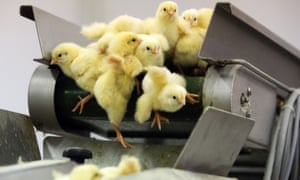
This history is alive and well in the modern chicken nugget. Poultry workers are paid very little: in the US, two cents for every dollar spent on a fast-food chicken goes to poultry workers. It’s hard to find staff when, according to one study in Alabama, 86% of employees who cut wings are in pain because of the repetitive hacking and twisting on the line. To fill the gaps in the labour force, some chicken operators use prison labour, paid at 25 cents an hour. In Oklahoma, chicken company executives returned to a colonial fusion of work and faith, setting up an addiction treatment centre in 2007, Christian Alcoholics & Addicts in Recovery. With judges steering addicts to treatment instead of jail, the recovery programme had a ready supply of workers. At CAAIR, prayer was supplemented with unpaid work on chicken productionlines as part of a recovery therapy. If you worked and prayed hard enough for the duration of your treatment, you’d be allowed to re-enter society.
Photograph: Bloomberg/Getty
CAAIR’s recruits were predominantly young and white, but the majority of poultry workers are people of colour. Latinx immigrants are a vital force in US agriculture, and the delivery of their cheap work was made possible by class restructuring on two fronts. One, in the US, was a strong movement in the 1980s by newly aggressive meat-packing firms to destroy union power and replace unionised workers with low-wage immigrant labour. The other was the destabilisation of Mexico’s agrarian order after 1994 by the North American Free Trade Agreement (Nafta), which resulted in flows of cheap immigrant labour – unemployed workers displaced by capitalism’s ecology from one side of the US border to the other.
Advertisement
A line on a map between two states is a powerful abstraction, one that has been used recently by the far right to recruit and spread fear, and for much longer by capitalists in search of ever cheaper and more profitable workers. Under capitalism, national territories, locally owned land and new migrating workers are produced simultaneously.
With migrant workers came elite fears of the itinerant poor. In 17th- and 18th-century England, this panic resulted in harsh laws against vagabondage, and the development of charities to ameliorate the worst effects of enforced destitution. Threats of imprisonment moved the poor into waged work, an act e seen similar advances through a combination of breeding, concentrated feeding operations and global supply chains. The consequences of the sustained rise in meat consumption are a planetary affair too: 14.5% of all anthropogenic carbon dioxide (CO2) emissions are from livestock production.
The environmental consequences of meat production are, of course, external to industrial agriculture’s bottom line. Nature is merely the pool from which animals are drawn and factory farmed, and the dump into which their, and our, waste disappears. The danger lies in believing the division between nature and society is real, in seeing “factory farming” as an environmental question and “factory production” as a social question. Social questions are environmental questions, and vice versa.
Chickens don’t turn into nuggets by themselves. Capitalists need cheap work. With the European invasion of the new world in 1492, that labour presented itself in the bodies of indigenous people. By the late 16th century, when Spaniards were desperately trying to revive silver production at the great silver mountain of Potosí, in present-day Bolivia, they began using the word naturales to refer to indigenous people. Through hard work and prayer, those indigenous people, and enslaved Africans, might find divine redemption through work and perhaps even, one day long in the future, entry into society as equals.
Work was never meant to be fun. Consider the etymology of the French travail and the Spanish trabajo, each a translation of the English noun “work”: their Latin root is trepaliare, “to torture, to inflict suffering or agony.” But the way work works has changed.
For millennia, most humans survived through more or less intimate relations with land and sea. Even those who didn’t were closely connected to the tasks and objects of labour. Human survival depended on holistic, not fragmented, knowledge: fishers, nomads, farmers, healers, cooks and many others experie ivity that took the intelligence, strength and dexterity of humans and disciplined them to productive labour using another modern invention: a new way of measuring time.
If the practice of labour shapes capitalism’s ecology, its indispensable machine is the mechanical clock. The clock – not money – emerged as the key technology for measuring the value of work. This distinction is crucial because it’s easy to think that working for wages is capitalism’s signature. It’s not: in 13th-century England only a third of the economically active population depended on wages for survival. That wages have become a decisive way of structuring life, space and nature owes everything to a new model of time.
By the early 14th century, the new temporal model was shaping industrial activity. In textile-manufacturing towns like Ypres, in what is now Belgium, workers found themselves regulated not by the flow of activity or the seasons but by a new kind of time – abstract, linear, repetitive. In Ypres, that work time was measured by the town’s bells, which rang at the beginning and end of each work shift. By the 16th century, time was measured in steady ticks of minutes and seconds. This abstract time came to shape everything – work and play, sleep and waking, credit and money, agriculture and industry, even prayer. By the end of the 16th century, most of England’s parishes had mechanical clocks.
Spain’s conquest of the Americas involved inculcating in their residents a new notion of time as well as of space. Wherever European empires penetrated, there appeared the image of the “lazy” native, ignorant of the imperatives of Christ and the clock. Policing time was central to capitalism’s ecology. As early as 1553, the Spanish crown began installing “at least one public clock” in its major colonial cities. Other civilisations had their own sophisticated temporal rules, but the new regimes of work displaced indigenous tempos and relationships with the natural world. The Mayan calendar is a complex hierarchy of times and readings from the heavens, offering a rich set of arrangements of humans within the universe. Spanish invaders respected it only to this extent: they synchronised their colonial assaults to sacred moments in the calendar.
As social historian EP Thompson observes in his seminal study Time, Work-Discipline and Industrial Capitalism, the governance of time follows a particular logic: “In mature capitalist society all time must be consumed, marketed, put to use; it is offensive for the labour force merely to ‘pass the time’.” The connection of specific activities to larger productive goals didn’t allow for time theft, and the discipline of the clock was enforced by violence across the planet.
Teaching the value and structure of capitalist time to new subjects was a key part of the colonial enterprise. One settler noted in 1859 that Indigenous Australians “now … have the advantage of dating from the ‘Nip Nip,’ or Settlers’ yearly regular shearing time. This seems to supply them with a mode of stating years, which before they had not. Months or moons then satisfied them.” But the regulation of time was also a focus of resistance. Another settler wrote in a diary: “This evening there was a grand Korroberry [sic, for corroboree, an exuberant, possibly spiritual, gathering] – I endeavoured to dissuade them, telling them that it was Sunday – but they said, ‘black fellow no Sunday.’” Why the resistance? Because they knew full well that their labour was the object of theft, that colonists were appropriating their work.
Fights over the regulation of time continue even now. On US poultry lines, there is a federal law limiting the speed at which birds are processed: 140 birds per minute. The industry is lobbying to eliminate the limit, so that it can compete with factories in Brazil and Germany, where the rate is nearer 200 bpm. Worries about higher rates of food contamination and worker injury are being outweighed by the certain profit from more dead chickens.
Capitalism has always experimented with every available kind of labour system simultaneously. A sugar plantation in 1630s Brazil, for example, would be easily recognisable as a modern industrial operation in, say, the Bangladeshi textile industry. Just as autoworkers on the line assemble simplified, interchangeable parts and fast-food workers manufacture standardised burgers, so did African slaves work specialised jobs in a simplified landscape of sugar monoculture.
Behind the modern factory, there has always been a layer-cake of exploitation. Managers of factories were salaried more than the workers, who worked with raw materials acquired through various kinds of peonage and natural resource exploitation, and all of them depended on free domestic labour, usually from women. The global factory depends on a global mine, a global farm, and a global family.
Hence the persistence today of slavery. One UN agency, the International Labour Organization, estimates there are 40 million people in slavery today, the majority of whom are women, many in forced marriages. Wartime work camps in, say, the Democratic Republic of the Congo supply the rare-earth metals such as tantalum that power the physical infrastructure behind the virtual economy.
But just as management looks to find new ways to generate profit, so workers find ways to resist. Early capitalism’s great commodity frontiers – of sugar, silver, copper, iron, forest products, fishing and even cereal agriculture – were zones of experimentation in strategies of labour control in Europe and its colonies, and always spaces of conflict. Strikes, rebellions, negotiations and resistance characterised the application of capitalist work disciplines. Every resistance by labour was a new reason to bring in machines. Modern work regimes and technologies emerged from the crucible of experiments, strategies and resistances of early modern workers.
Worker unrest in factories and slave rebellions, past and present, are linked not just because they are expressions of resistance, but because they are protests against the ecology of capitalism. Every global factory needs a global farm: industrial, technological and service enterprises rely on the extraction of work and cheap nature to thrive. The apps on your iPhone, designed in Cupertino, California, might have been coded by self-exploiting independent software engineers, and the phone itself assembled in draconian workplaces in China, and run on minerals extracted in inhumane conditions in the Congo. Modern manufacturing relies on layered, simultaneous and different regimes of work. And in response to every act of resistance against it, capitalism has moved the frontiers of work yet again.
Hegemony over workers has been aided by cheap food, and the promise of a chicken in every pot. Cheap food has been central to the maintenance of order for millennia. But in the ecology of capitalism, that order has been maintained through planetary transformation.
Since the 15th century, some land has become the exclusive domain of specific kinds of crops and crop systems: fields of monocultures designed to bring in flows of cash. Other areas were reserved to house those humans who had been excommunicated from those lands, to be better placed at the service of capitalists in cities. It was always a socially unstable geography, with low industrial wages supported by lower peasant wages supported by free gifts from nature, women and the colonies. After the revolutions of the 19th and 20th centuries offered workers the promise of alternatives to exploitation, capitalist fears of urban uprising and communism reached fever pitch. To allay this existential dread, governments and foundations did not address inequality or exploitation. Instead, they funded the development of crops that would grow abundantly enough to provide cheap food and curb urban hunger.
That it was urban, and not rural, hunger that troubled policy makers is vitally important. Food and employment for people in rural areas – where most of the world’s hunger was concentrated – were of little concern. Hunger began to matter politically only when the poor came to the cities and translated it into anger, and thence potentially into insurrection and a challenge to the rule of cheap nature. It’s here – in the bourgeois concern about that rule and its need for worker quiescence – that we find the origin of what came to be known as the Green Revolution.
CAAIR’s recruits were predominantly young and white, but the majority of poultry workers are people of colour. Latinx immigrants are a vital force in US agriculture, and the delivery of their cheap work was made possible by class restructuring on two fronts. One, in the US, was a strong movement in the 1980s by newly aggressive meat-packing firms to destroy union power and replace unionised workers with low-wage immigrant labour. The other was the destabilisation of Mexico’s agrarian order after 1994 by the North American Free Trade Agreement (Nafta), which resulted in flows of cheap immigrant labour – unemployed workers displaced by capitalism’s ecology from one side of the US border to the other.
Advertisement
A line on a map between two states is a powerful abstraction, one that has been used recently by the far right to recruit and spread fear, and for much longer by capitalists in search of ever cheaper and more profitable workers. Under capitalism, national territories, locally owned land and new migrating workers are produced simultaneously.
With migrant workers came elite fears of the itinerant poor. In 17th- and 18th-century England, this panic resulted in harsh laws against vagabondage, and the development of charities to ameliorate the worst effects of enforced destitution. Threats of imprisonment moved the poor into waged work, an act e seen similar advances through a combination of breeding, concentrated feeding operations and global supply chains. The consequences of the sustained rise in meat consumption are a planetary affair too: 14.5% of all anthropogenic carbon dioxide (CO2) emissions are from livestock production.
The environmental consequences of meat production are, of course, external to industrial agriculture’s bottom line. Nature is merely the pool from which animals are drawn and factory farmed, and the dump into which their, and our, waste disappears. The danger lies in believing the division between nature and society is real, in seeing “factory farming” as an environmental question and “factory production” as a social question. Social questions are environmental questions, and vice versa.
Chickens don’t turn into nuggets by themselves. Capitalists need cheap work. With the European invasion of the new world in 1492, that labour presented itself in the bodies of indigenous people. By the late 16th century, when Spaniards were desperately trying to revive silver production at the great silver mountain of Potosí, in present-day Bolivia, they began using the word naturales to refer to indigenous people. Through hard work and prayer, those indigenous people, and enslaved Africans, might find divine redemption through work and perhaps even, one day long in the future, entry into society as equals.
Work was never meant to be fun. Consider the etymology of the French travail and the Spanish trabajo, each a translation of the English noun “work”: their Latin root is trepaliare, “to torture, to inflict suffering or agony.” But the way work works has changed.
For millennia, most humans survived through more or less intimate relations with land and sea. Even those who didn’t were closely connected to the tasks and objects of labour. Human survival depended on holistic, not fragmented, knowledge: fishers, nomads, farmers, healers, cooks and many others experie ivity that took the intelligence, strength and dexterity of humans and disciplined them to productive labour using another modern invention: a new way of measuring time.
If the practice of labour shapes capitalism’s ecology, its indispensable machine is the mechanical clock. The clock – not money – emerged as the key technology for measuring the value of work. This distinction is crucial because it’s easy to think that working for wages is capitalism’s signature. It’s not: in 13th-century England only a third of the economically active population depended on wages for survival. That wages have become a decisive way of structuring life, space and nature owes everything to a new model of time.
By the early 14th century, the new temporal model was shaping industrial activity. In textile-manufacturing towns like Ypres, in what is now Belgium, workers found themselves regulated not by the flow of activity or the seasons but by a new kind of time – abstract, linear, repetitive. In Ypres, that work time was measured by the town’s bells, which rang at the beginning and end of each work shift. By the 16th century, time was measured in steady ticks of minutes and seconds. This abstract time came to shape everything – work and play, sleep and waking, credit and money, agriculture and industry, even prayer. By the end of the 16th century, most of England’s parishes had mechanical clocks.
Spain’s conquest of the Americas involved inculcating in their residents a new notion of time as well as of space. Wherever European empires penetrated, there appeared the image of the “lazy” native, ignorant of the imperatives of Christ and the clock. Policing time was central to capitalism’s ecology. As early as 1553, the Spanish crown began installing “at least one public clock” in its major colonial cities. Other civilisations had their own sophisticated temporal rules, but the new regimes of work displaced indigenous tempos and relationships with the natural world. The Mayan calendar is a complex hierarchy of times and readings from the heavens, offering a rich set of arrangements of humans within the universe. Spanish invaders respected it only to this extent: they synchronised their colonial assaults to sacred moments in the calendar.
As social historian EP Thompson observes in his seminal study Time, Work-Discipline and Industrial Capitalism, the governance of time follows a particular logic: “In mature capitalist society all time must be consumed, marketed, put to use; it is offensive for the labour force merely to ‘pass the time’.” The connection of specific activities to larger productive goals didn’t allow for time theft, and the discipline of the clock was enforced by violence across the planet.
Teaching the value and structure of capitalist time to new subjects was a key part of the colonial enterprise. One settler noted in 1859 that Indigenous Australians “now … have the advantage of dating from the ‘Nip Nip,’ or Settlers’ yearly regular shearing time. This seems to supply them with a mode of stating years, which before they had not. Months or moons then satisfied them.” But the regulation of time was also a focus of resistance. Another settler wrote in a diary: “This evening there was a grand Korroberry [sic, for corroboree, an exuberant, possibly spiritual, gathering] – I endeavoured to dissuade them, telling them that it was Sunday – but they said, ‘black fellow no Sunday.’” Why the resistance? Because they knew full well that their labour was the object of theft, that colonists were appropriating their work.
Fights over the regulation of time continue even now. On US poultry lines, there is a federal law limiting the speed at which birds are processed: 140 birds per minute. The industry is lobbying to eliminate the limit, so that it can compete with factories in Brazil and Germany, where the rate is nearer 200 bpm. Worries about higher rates of food contamination and worker injury are being outweighed by the certain profit from more dead chickens.
Capitalism has always experimented with every available kind of labour system simultaneously. A sugar plantation in 1630s Brazil, for example, would be easily recognisable as a modern industrial operation in, say, the Bangladeshi textile industry. Just as autoworkers on the line assemble simplified, interchangeable parts and fast-food workers manufacture standardised burgers, so did African slaves work specialised jobs in a simplified landscape of sugar monoculture.
Behind the modern factory, there has always been a layer-cake of exploitation. Managers of factories were salaried more than the workers, who worked with raw materials acquired through various kinds of peonage and natural resource exploitation, and all of them depended on free domestic labour, usually from women. The global factory depends on a global mine, a global farm, and a global family.
Hence the persistence today of slavery. One UN agency, the International Labour Organization, estimates there are 40 million people in slavery today, the majority of whom are women, many in forced marriages. Wartime work camps in, say, the Democratic Republic of the Congo supply the rare-earth metals such as tantalum that power the physical infrastructure behind the virtual economy.
But just as management looks to find new ways to generate profit, so workers find ways to resist. Early capitalism’s great commodity frontiers – of sugar, silver, copper, iron, forest products, fishing and even cereal agriculture – were zones of experimentation in strategies of labour control in Europe and its colonies, and always spaces of conflict. Strikes, rebellions, negotiations and resistance characterised the application of capitalist work disciplines. Every resistance by labour was a new reason to bring in machines. Modern work regimes and technologies emerged from the crucible of experiments, strategies and resistances of early modern workers.
Worker unrest in factories and slave rebellions, past and present, are linked not just because they are expressions of resistance, but because they are protests against the ecology of capitalism. Every global factory needs a global farm: industrial, technological and service enterprises rely on the extraction of work and cheap nature to thrive. The apps on your iPhone, designed in Cupertino, California, might have been coded by self-exploiting independent software engineers, and the phone itself assembled in draconian workplaces in China, and run on minerals extracted in inhumane conditions in the Congo. Modern manufacturing relies on layered, simultaneous and different regimes of work. And in response to every act of resistance against it, capitalism has moved the frontiers of work yet again.
Hegemony over workers has been aided by cheap food, and the promise of a chicken in every pot. Cheap food has been central to the maintenance of order for millennia. But in the ecology of capitalism, that order has been maintained through planetary transformation.
Since the 15th century, some land has become the exclusive domain of specific kinds of crops and crop systems: fields of monocultures designed to bring in flows of cash. Other areas were reserved to house those humans who had been excommunicated from those lands, to be better placed at the service of capitalists in cities. It was always a socially unstable geography, with low industrial wages supported by lower peasant wages supported by free gifts from nature, women and the colonies. After the revolutions of the 19th and 20th centuries offered workers the promise of alternatives to exploitation, capitalist fears of urban uprising and communism reached fever pitch. To allay this existential dread, governments and foundations did not address inequality or exploitation. Instead, they funded the development of crops that would grow abundantly enough to provide cheap food and curb urban hunger.
That it was urban, and not rural, hunger that troubled policy makers is vitally important. Food and employment for people in rural areas – where most of the world’s hunger was concentrated – were of little concern. Hunger began to matter politically only when the poor came to the cities and translated it into anger, and thence potentially into insurrection and a challenge to the rule of cheap nature. It’s here – in the bourgeois concern about that rule and its need for worker quiescence – that we find the origin of what came to be known as the Green Revolution.
The aim was to breed varieties of cereals that might flow freely through urban areas. But the revolution wasn’t simply an agronomic transformation. It required more than magic seeds. In order for farmers to grow the crops, national governments had to subsidise the purchase of crops through agricultural marketing boards, to lay the infrastructure for irrigation, and to suppress political dissent around alternative food systems. The Green Revolution of the early- to mid-20th century was a package of reforms designed to prevent the revolutionary political goal of many peasants’ and landless workers’ movements: comprehensive land and agrarian reform.