Addiction Commonality

Alcohol, Opiates, Fat and Sugar are all Addictive Substances: this blog is about that "addiction sameness".

Butter Pig Family

* A butter sculpture of a sow and her piglets

Saturday, March 16, 2019

The toxic truth about modern food


Good enough to eat? 

The toxic truth about modern food 

https://www.theguardian.com/books/2019/mar/16/snack-attacks-the-toxic-truth-about-the-way-we-eat?CMP=share_btn_tw


Good enough to eat? The toxic truth about modern food

We are now producing and consuming more food than ever, and yet our modern diet is killing us. How can we solve this bittersweet dilemma?

by 


Pick a bunch of green grapes, wash it, and put one in your mouth. Feel the grape with your tongue, observe how cold and refreshing it is: the crisp flesh, and the jellylike interior with its mild, sweet flavour.


Eating grapes can feel like an old pleasure, untouched by change. The ancient Greeks and Romans loved to eat them, as well as to drink them in the form of wine. The Odyssey describes “a ripe and luscious vine, hung thick with grapes”. As you pull the next delicious piece of fruit from its stalk, you could easily be plucking it from a Dutch still life of the 17th century, where grapes are tumbled on a metal platter with oysters and half-peeled lemons.


But look closer at this bunch of green grapes, cold from the fridge, and you see that they are not unchanged after all. Like so many other foods, grapes have become a piece of engineering designed to please modern eaters. First of all, there are almost certainly no seeds for you to chew or spit out (unless you are in certain places such as Spain where seeded grapes are still part of the culture). Strains of seedless varieties have been cultivated for centuries, but it is only in the past two decades that seedless has become the norm, to spare us the dreadful inconvenience of pips.
Here is another strange new thing about grapes: the ones in the supermarket such as Thompson Seedless and Crimson Flame are always sweet. Not bitter, not acidic, not foxy like a Concord grape, not excitingly aromatic like one of the Muscat varieties, but just plain sweet, like sugar. On biting into a grape, the ancients did not know if it would be ripe or sour. The same was true, in my experience, as late as the 1990s. It was like grape roulette: a truly sweet one was rare and therefore special. These days, the sweetness of grapes is a sure bet, because in common with other modern fruits such as red grapefruit and Pink Lady apples, our grapes have been carefully bred and ripened to appeal to consumers reared on sugary foods. Fruit bred for sweetness does not have to be less nutritious, but modern de-bittered fruits tend to contain fewer of the phytonutrients that give fruits and vegetables many of their protective health benefits. Such fruit still gives us energy, but not necessarily the health benefits we would expect.
The very fact that you are nibbling seedless grapes so casually is also new. I am old enough to remember a time when grapes – unless you were living in a grape-producing country – were a special and expensive treat. But now, millions of people on average incomes can afford to behave like the reclining Roman emperor of film cliche, popping grapes into our mouths one by one. Globally, we both produce and consume twice as many as we did in the year 2000. They are an edible sign of rising prosperity, because fruit is one of the first little extras that people spend money on when they start to have disposable income. Their year-round availability also speaks to huge changes in global agriculture. Fifty years ago, table grapes were a seasonal fruit, grown in just a few countries and only eaten at certain times of year. Today, they are cultivated globally and never out of season.


What we eat now is a greater cause of disease and death in the world than either tobacco or alcohol
Almost everything about grapes has changed, and fast. And yet they are the least of our worries when it comes to food, just one tiny element in a much larger series of kaleidoscopic transformations in how and what we eat that have happened in recent years. These changes are written on the land, on our bodies and on our plates (insofar as we even eat off plates any more).


With Brexit, food worries in the UK have become political, with panicked discussions of stockpiling and the spectre of US imports of chlorine-treated chicken on the horizon. Woody Johnson, the US ambassador to the UK, has dismissed these worries, suggesting that US food standards are nothing to be concerned about. But the bigger question is not whether American standards are lower than those in Britain, but why food standards across the world have been allowed to sink so dramatically.
What we eat now is a greater cause of disease and death in the world than either tobacco or alcohol. In 2015 around 7 million people died from tobacco smoke, and 2.75 million from causes related to alcohol, but 12m deaths could be attributed to “dietary risks” such as diets low in vegetables, nuts and seafood or diets high in processed meats and sugary drinks. This is paradoxical and sad, because good food – good in every sense, from flavour to nutrition – used to be the test by which we judged the quality of life. A good life without good food should be a logical impossibility.


Where humans used to live in fear of plague or tuberculosis, now the leading cause of mortality worldwide is diet. Most of our problems with eating come down to the fact that we have not yet adapted to the new realities of plenty, either biologically or psychologically. Many of the old ways of thinking about diet no longer apply, but it isn’t clear yet what it would mean to adapt our appetites and routines to the new rhythms of life. We take our cues about what to eat from the world around us, which becomes a problem when our food supply starts to send us crazy signals about what is normal. “Everything in moderation” doesn’t quite cut it in a world where the “everything” for sale in the average supermarket has become so sugary and so immoderate.

At no point in history have edible items been so easy to obtain, and in many ways this is a glorious thing. Humans have always gone out and gathered food, but never before has it been so simple for us to gather anything we want, whenever we want it, from sachets of black squid ink to strawberries in winter. We can get sushi in Buenos Aires, sandwiches in Tokyo and Italian food everywhere. Not so long ago, to eat genuine Neapolitan pizza, a swollen-edged disc of dough cooked in a blistering oven, you had to go to Naples. Now, you can find Neapolitan pizza – made using the right dough blasted in an authentic pizza oven – as far afield as Seoul and Dubai.

Talking about what has gone wrong with modern eating is delicate, because food is a touchy subject. No one likes to feel judged about their food choices, which is one of the reasons why so many healthy eating initiatives fail. The rise of obesity and diet-related disease around the world has happened hand in hand with the marketing of fast food and sugary sodas, of processed meats and branded snack foods. As things stand, our culture is far too critical of the individuals who eat junk foods and not critical enough of the corporations who profit from selling them. A survey of more than 300 international policymakers found that 90% of them still believed that personal motivation – AKA willpower – was a very strong cause of obesity. This is absurd.

It makes no sense to presume that there has been a sudden collapse in willpower across all ages and ethnic groups since the 1960s. What has changed most since the 60s is not our collective willpower but the marketing and availability of energy-dense, nutrient-poor foods. Some of these changes are happening so rapidly it’s almost impossible to keep track. Sales of fast food grew by 30% worldwide from 2011 to 2016 and sales of packaged food grew by 25%. Somewhere in the world, a new branch of Domino’s Pizza opened every seven hours in 2016


.

Zhongshan Snack Street, a market in Nanning, Guangxi province, China. Photograph: Aleksandar Tomic/Alamy Stock Photo/Alamy Stock Photo


But this story isn’t just about one kind of food or one set of people. Across the board, across all social classes, most of us eat and drink more than our grandparents did, whether we are cooking a leisurely dinner at home from fresh ingredients or grabbing a takeaway from a fast food chain. Plates are bigger than they were 50 years ago, our idea of a portion is inflated and wine glasses are vast. It has become normal to punctuate the day with snacks and to quench our thirst with calorific liquids, from green juice and detox shots to craft sodas (which are just like any other soda, only more expensive). As the example of grapes shows, we don’t just eat more burgers and fries than our grandparents, we also eat more fruit and avocado toast and frozen yoghurt, more salad dressing and many, many more “guilt-free” kale crisps.

Barry Popkin, a professor of nutrition at Chapel Hill University, North Carolina, can identify the year when snacking took off in China. It was 2004. Before that, the Chinese consumed very little between meals except green tea and hot water. In 2004, Popkin suddenly noticed a marked transition from the old Chinese ways of two or three meals a day towards a new pattern of eating. In collaboration with a team of Chinese nutritionists, he has been following the Chinese diet in snapshots of data every two or three years, conducting regular surveys of around 10,000-12,000 people. Back in 1991, Popkin found that at certain fixed times of year, there were treats to supplement the daily diet. During the mid-autumn festival, for example, people would eat moon cakes made from lard-enriched pastry stuffed with sweetened bean paste. But such feasting foods were ritualised and rare, nothing like a casual cereal bar.

In 2004, out of nowhere, as incomes rose, Chinese habits of snacking spread dramatically. The number of Chinese adults between 19 and 44 describing themselves as eating snacks over a three-day period nearly doubled, while the number of children between two and six eating snacks rose almost as much. Based on the most recent data, more than two-thirds of Chinese children now report snacking during the day. This is an eating revolution.

The curious thing about snacking in China is that to start with it actually made people healthier, because they were snacking on fruit: fresh tangerines and kumquats, bayberries and lychees, pineapple and pomelo. These were the foods that people had always aspired to eat, but couldn’t afford in the past. Phase two of snacking in China has been very different. “The marketing comes in,” Popkin tells me, “and boom! boom! boom! the snacks are not healthy any more.” As of 2015, the commercial savoury snack food market in China was worth more than $7bn. When I travelled to Nanjing last year, I saw people consuming the same Starbucks Frappuccinos and blueberry muffins as in London.

China is not alone. Almost every country in the world has experienced radical changes to its patterns of eating over the past five, 10 and 50 years. For a long time, nutritionists have held up the “Mediterranean diet” as a healthy model for people in all countries to follow. But recent reports from the World Health Organisation suggest that even in Spain, Italy and Crete, most children no longer eat anything like a “Mediterranean diet” rich in olive oil and fish and tomatoes. These Mediterranean children, who are, as of 2017, among the most overweight in Europe, now drink sugary colas and eat packaged snack foods and have lost the taste for fish and olive oil. In every continent, there has been a common set of changes from savoury foods to sweet ones, from meals to snacks, dinners cooked at home to meals eaten out, or takeaways


.
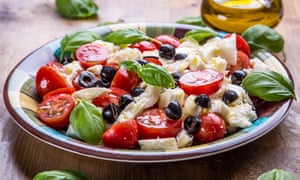
 In Spain, Italy and Crete, most children no longer eat anything like a ‘Mediterranean diet’. Photograph: Alamy Stock Photo

The nutrient content of our meals is one thing that has radically changed; the psychology of eating is another. Much of our eating takes place in a new chaotic atmosphere in which we no longer have many rules to fall back on. On an early evening train journey recently, I looked up at my fellow travellers and noticed, first, that almost everyone was eating or drinking and second, that they were all doing so in ways that might once have been considered deeply eccentric. One man had both a cappuccino and a can of fizzy drink from which he was taking alternate sips. A woman with headphones on was nibbling an apricot tart, produced from a cardboard patisserie box. She followed it with a high-protein snackpot of two hard-boiled eggs and some raw spinach. Sitting across from her was a man carrying a worn leather briefcase. He reached inside and produced a bottle of strawberry milkshake and a half-finished packet of chocolate-caramel sweets.


More than half of the calorie intake in the US – 57.9% – now consists of ultra-processed food, and the UK is not far behind

We are often told in a slightly hectoring way that we should make “better” or “smarter” food choices, yet the way we eat now is the product of vast impersonal forces that none of us asked for. The choices we make about food are largely predetermined by what’s available and by the limitations of our busy lives. If you go into the average western out-of-town supermarket, you can choose from thousands of different sugary snack bars (many of them protein enhanced in some way) but only one variety of banana, the bland Cavendish.

It might be possible to eat in a more balanced way, if only we didn’t have to work, or go to school, or save money, or travel by car, bus or train, or shop at a supermarket, or live in a city, or share a meal with children, or look at a screen, or get up early, or stay up late, or walk past a vending machine, or feel depressed, or be on medication, or have a food intolerance, or own an imperfectly stocked fridge. Who knows what wonders we might then eat for breakfast?



A line of fast-food restaurants in Los Angeles, US. Photograph: David McNew/Getty Images


Our culture’s obsessive focus on a perfect physique has blinded us to the bigger question, which is what anyone of any size should eat to avoid being sickened by our unbalanced food supply. No one can eat themselves to perfect health, nor can we ward off death indefinitely, and the attempt to do so can drive a person crazy. Life is deeply unfair and some people may eat every dark green leafy vegetable going and still get cancer. But even if food cannot cure or forestall every illness, it does not have to be the thing that kills us. The greatest thing that we have lost from our eating today is a sense of balance, whether it’s the balance of meals across the day or the balance of nutrients on our plate.

“There are so many myths about food,” says Fumiaki Imamura, an epidemiologist who has spent the past 16 years in the west, studying the links between diet and health. One of the food myths Imamura refers to is the notion that there is such a thing as a perfectly healthy diet. He offers himself as an example. Like many Japanese people, he eats a diet rich in fish and vegetables, but he also eats a fair amount of supposedly “unhealthy” refined white rice and high-salt soy sauce. But Imamura is conscious that no population in the world eats exactly the combination of healthy foods that a nutritionist might prescribe.

Every human community across the globe eats a mixture of the “healthy” and the “unhealthy”, but the salient question is where the balance falls. Take ultra-processed foods. The occasional bowl of instant ramen noodles or frosted cereal is no cause for panic. But when ultra-processed foods start to form the bulk of what whole populations eat on any given day, we are in new and disturbing territory for human nutrition. More than half of the calorie intake in the US – 57.9% – now consists of ultra-processed food, and the UK is not far behind, with a diet that is around 50.4% ultra-processed. The fastest growing ingredient in global diets is not sugar, as I’d always presumed, but refined vegetable oils such as soybean oil, which are a common ingredient in many fast and processed foods, and which have added more calories to what we eat over the past 50 years than any other food group, by a wide margin.


The highest-quality overall diets in the world are mostly to be found not in rich countries but in Africa

In 2015, Imamura was the lead author on a paper in the medical journal the Lancet, which caused a stir in the world of nutrition science. This team of epidemiologists – based at Tufts University and led by Professor Dariush Mozaffarian – has been seeking to map the healthiness, or otherwise, of how people eat across the entire world, and how this changed in the 20 years between 1990 and 2010. The biggest surprise to come out of the data was that the highest-quality overall diets in the world are mostly to be found not in rich countries but in Africa, mostly in the sub-Saharan regions. The 10 countries with the healthiest diet patterns, listed in order with the healthiest first, came out as: Chad, Mali, Cameroon, Guyana, Tunisia, Sierra Leone, Laos, Nigeria, Guatemala, French Guiana.

Meanwhile, the 10 countries with the least healthy diet patterns, listed in order with the unhealthiest first, were: Armenia, Hungary, Belgium, USA, Russia, Iceland, Latvia, Brazil, Colombia, Australia.

The idea that healthy diets can only be attained by rich countries is one of the food myths, Imamura says. He found that the populations of Sierra Leone, Mali and Chad have diets that are closer to what is specified in health guidelines than those of Germany or Russia. Diets in sub-Saharan Africa are unusually low in unhealthy items and high in healthy ones. If you want to find the people who eat the most wholegrains, you will either have to look to the affluent Nordic countries where they still eat rye bread or to the poor countries of sub-Saharan Africa, where nourishing grains such as sorghum, maize, millet and teff are made into healthy main dishes usually accompanied by some kind of stew, soup or relish.

It was Imamura’s conclusion about the high quality of African diets that ruffled feathers in the world of public health. What about African hunger and scarcity? If the people of Cameroon consume low amounts of sugar and processed meat, it is partly because they are consuming low amounts of food all round.



Amsterdam has been the first rich city in the world to bring down child obesity. Photograph: Alamy Stock Photo


Imamura does not deny, he tells me, that the quantity of food available is very low in some of the African countries, but adds: “That’s not the point of our study. We were looking at quality.” His paper was predicated on the assumption that everyone in the world was consuming 2,000 calories a day. Imamura was well aware that is far from the case in sub-Saharan Africa, where the prevalence of malnourishment is around 24% according to the Food and Agriculture Organisation. But he and his colleagues wanted to isolate the question of food quality from that of quantity.

For 50 years or more, our food system has been blindly fixated on the question of quantity. Since the end of rationing after the second world war, our agricultural systems have been focused on supplying populations with enough food, without considering whether that “food” was beneficial for human health. But now there are glimmers of a return to quality, with an acknowledgement in public health circles that food is more than just a question of calories in and calories out. With Brexit, there has been belated recognition in the UK that the quality of the food we eat is not something we can just take for granted. At a meeting in Westminster Hall earlier this

month, Sharon Hodgson, the shadow minister for public health, warned that a no-deal Brexit would be disastrous for the quality of food served by public caterers in schools, hospitals and prisons.


In the land of The Great British Bake Off, celebrating a child’s birthday with olives instead of sugar might sound weird


Brexit or no Brexit, it’s becoming abundantly clear that the way most of us currently eat is not sustainable – either for the planet or for human health. The hope is that some governments and cities around the world are already taking action to create environments in which it is easier to feed ourselves in a manner that is both healthy and joyous.

Amsterdam has been the first rich city in the world to bring down child obesity, through the Amsterdam healthy weight programme (AHWP). From 2012 to 2015 the percentage of children there who are overweight or obese declined by 12%. The AHWP worked on many fronts at once, from banning junk-food marketing at sporting events to increasing water fountains in the city. But the guiding philosophy behind all the actions was to change collective ideas about what is normal when it comes to food and health. Now, when a child celebrates a birthday in an Amsterdam school, he or she cannot bring in packs of cookies or Haribos. Instead, a popular option is a selection of vegetable skewers to share with friends, consisting of tomatoes, cubes of cheese and green olives. Celebrate with olives!

Here in the land of The Great British Bake Off, celebrating a child’s birthday with olives instead of sugar might sound weird. If schools tried to enact such a plan in the UK, you can be sure that the usual chorus of critics would denounce it as “middle-class”. But there is nothing middle-class about the desire to eat food that brings us both health and happiness.

To reverse the worst of modern diets and save the best would require many other things to change about the world today, from the way we organise agriculture to the way we talk about vegetables. A smart and effective food policy would seek to create an environment in which a love of healthy food was easier to adopt, and it would also reduce the barriers to people actually buying and eating that food. None of this looks easy at present, but nor is such change impossible. If the transformations we are living through now teach us anything, it is that humans are capable of altering almost everything about our eating in a single generation.

• Bee Wilson’s The Way We Eat Now is published by 4th Estate on Thursday

.


Topics


Diets and dieting
Health
Food (global)
Food (Environment)
Food and drink books
Food & drink industry
features


Source: https://www.theguardian.com/books/2019/mar/16/snack-attacks-the-toxic-truth-about-the-way-we-eat?CMP=twt_gu


Friday, March 15, 2019

Fireside Chat with Dean Ornish, MD, & Anne Ornish, Preventative Medicine...


Fireside Chat with Dean Ornish, MD, and Anne Ornish, Preventative Medicine


Dean Ornish, MD & Anne Ornish, Preventative Medicine Research Institute, discuss their new book: "Undo It!: How Simple Lifestyle Changes Can Reverse Most Chronic Diseases' with Dr. Howard Krein, Chief Medical Officer, StartUp Health at the 2019 StartUp Health Festival in San Francisco, California

WATCH MORE EPISODES HERE: https://www.startuphealth.com/startup...
#DeanOrnish
#AnneOrnish
#Preventivemedicine


Dr. Dean Ornish: UnDo It! Reversing Chronic Disease with Lifestyle


Living with multiple sclerosis


Living with multiple sclerosis has necessitated choosing a healthy lifestyle and Dean Ornish provided the best science based healthful living ideas.


Dr. Dean Ornish has been our food guide since I read his first book.  Nathan Pritikin had already influence my thinking about healthy eating.  Ornish has produced many science based studies, unlike most diet gurus that simply make unsubstantiated claims.   He has continuously expanded his lifestyle medicine applications so i'm passing on updated information. 


The author, Dean Ornish, founder of the nonprofit Preventive Medicine Research Institute, is no newcomer to these nutrition debates. For 41 years he has been touting the benefits of very low-fat, high-carbohydrate, vegetarian diets for preventing and reversing heart disease  


Dr. Dean Ornish: UnDo It! Reversing Chronic Disease with Lifestyle


Dr. Dean Ornish is the founder and president of the nonprofit Preventive Medicine Research Institute, clinical professor of medicine at the University of California, San Francisco, and the author of six books, all national bestsellers. He has received numerous honors, including the Outstanding Sound Alumnus Award from the University of Texas, Austin, and the National Public Health Hero Award from the University of California, Berkley. Dr. Ornish was recognized as a "Time 100 Innovator"; by Life magazine as "one of the 50 most influential members of his generation"; by People as "one of the most interesting people of the year"; and by Forbes as "one of the world's seven most powerful teachers."

In this interview we discuss his new book, "UnDo It! How simple lifestyle changes can reverse most chronic diseases." His tenants are Eat Well (hint...it's plants), Move More, Stress Less, Love More. Dr. Ornish is such a joy to speak to and we had an incredible discussion and he shared his past that brought the insight of lifestyle interventions to reverse chronic disease. After almost 40 years of research (which could fill a volume of books), Dr. Ornish, has the expertise and experience to help lead to a brighter future! Please share this interview and check out Dr. Ornish's book, here.
https://undoitbook.com

Find out more about Dr. Ornish at
http://ornish.com.
Facebook.com/ornish
Twitter: @deanornishmd

Thank you for listening and sharing! Please rate our podcast where you listen and check out many amazing resources we offer about the whole food plant based diet at


Wednesday, January 9, 2019

Reversing Type 2 diabetes - Dr. Sarah Hallberg


Reversing Type 2 diabetes starts with ignoring the guidelines | Sarah Hallberg | TEDxPurdueU


Can a person be "cured" of Type 2 Diabetes? Dr. Sarah Hallberg provides
compelling evidence that it can, and the solution is simpler than you
might think. 

 Dr. Sarah Hallberg is the Medical Director of the Medically Supervised
Weight Loss Program at IU Health Arnett, a program she created. 

She is
board certified in both obesity medicine and internal medicine and has a
Master’s Degree in Exercise Physiology. 

She has recently created what
is only the second non-surgical weight loss rotation in the country for
medical students. 

Her program has consistently exceeded national
benchmarks for weight loss, and has been highly successful in reversing
diabetes and other metabolic diseases. 

Dr. Hallberg is also the
co-author of www.fitteru.us, a blog about health and wellness.


B.S., Kinesiology and Exercise Science, Illinois State University,
1994


M.S., Kinesiology and Exercise Science, Illinois State University,
1996


M.D., Des Moines University, 2002 

This talk was given at a TEDx event using the TED conference format but
independently organized by a local community. Learn more at http://ted.com/tedx


A Guide to the Different Types of Fat


A Guide to the Different Types of Fat

A Guide to Different Types of Fat

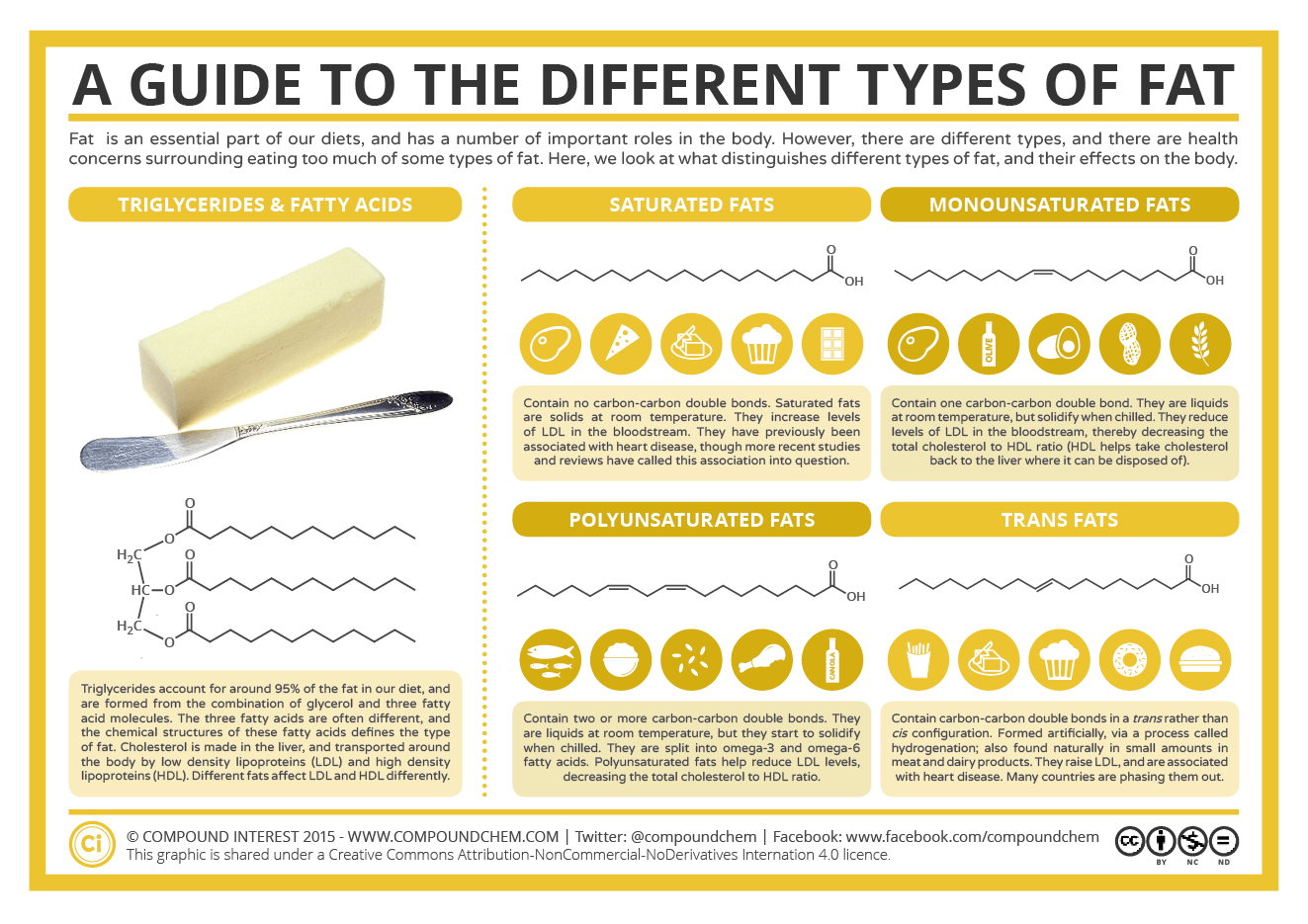
Fat is an important nutrient in our diets, but there’s a lot of talk of different types of fats, and whether these types are beneficial or harmful to our health. These different fat classifications have their roots in chemistry – and chemistry can also help explain their effects. This graphic takes a look at the different classifications, their sources, and briefly about how they act in our body.

Firstly, it’s worth emphasising that fat has an important role to play in a balanced diet. The fat in our diets is a source of some ‘fatty acids’ that are termed ‘essential’: that is, the body is unable to make them itself, and relies on our diets as their source. They’re required because they help the body absorb vitamins that are fat-soluble. We’ve looked at vitamins before in a previous post – the vitamins that fats help to absorb are vitamins A, D, E and K. Additionally, fats help provide us with energy, and they are also important for a variety of functions in the body.

Fats also play an important role in the body with respect to cholesterol. Cholesterol is a substance we produce in our livers, and it is also present in some foods. Animal cells require cholesterol to maintain their cell membranes, and it’s transported in the blood by lipoproteins. There are a number of types of these proteins, but the carriers we’re mainly interested in when discussing fats are low density lipoproteins (LDL) and high density lipoproteins (HDL).

Discussion of LDL and HDL is often simplified to referring to them as ‘bad’ and ‘good’ cholesterol respectively. However, despite this perhaps over-simplified nomenclature, both are required; it’s the levels of each that are important. Cholesterol is still the same molecule in both cases, it’s merely the carrier that differs. LDL are the main cholesterol carriers in the bloodstream, but if their levels become too high, they can collect in the walls of blood vessels. As such, it’s generally thought that higher LDL levels are associated with detrimental health effects. HDL, on the other hand, helps transport cholesterol back to the liver, and as such higher HDL levels (as a percentage of total blood cholesterol) have been correlated with better health. Different fats can affect LDL and HDL in different ways.

So how do we distinguish between the different types of fat? Dietary fat comes primarily in the form of triglycerides. These are large molecules, consisting of a backbone based on the molecule glycerol, to which three different fatty acid chains are attached. Those with some chemistry knowledge will know that, in chemistry, we also refer to fatty acids as carboxylic acids. The chemical identities of these fatty acids is variable – in a particular triglyceride, it’s common for the three fatty acids to all be different. 

It’s the chemical identities of the fatty acids that make up a triglyceride that we’re discussing when we talk about types of fat. There are four types we’ll discuss here: saturated fat, monounsaturated fat, polyunsaturated fat, and trans fat. Though the focus of this graphic is primarily on the differences in chemical structure and sources, I’ll also briefly discuss what we know about how they act in the body.


Saturated Fat


Fatty acids which contain no carbon-carbon double bonds are referred to as saturated fats. This type of fat is found in foods including meats, cheeses, dairy products, cakes, and chocolate. For a long time, saturated fats were the bad guys of the fat world – government guidelines recommended keeping their intake to a minimum, and high dietary saturated fat intake was associated with increased risk of coronary heart disease. Saturated fats do increase the levels of LDL in the bloodstream, so this seemed like a sensible suggestion.

However, in recent years, the assumption that saturated fat is unquestionably bad for you has been challenged. The original study that prompted the guidance of many of the world’s governments has been criticised for scientific flaws. Today, it remains unclear how big a factor saturated fat is with respect to heart disease.


Monounsaturated Fat
Fatty acids which contain, at some point in their chemical structure, one carbon-carbon double bond are known as monounsaturated fats. They are found in high levels in red meat, nuts, high fat fruits such as avocados, and olive oil. Unlike saturated fats, they lower the levels of LDL in the blood, whilst maintaining HDL levels. As such, they improve the HDL to total blood cholesterol ratio in favour of HDL, and they’re thought to be beneficial to health. 

Polyunsaturated Fat

Fatty acids which contain a number of carbon-carbon double bonds within their chemical structure are known as polyunsaturated fats. Two commonly mentioned subtypes are omega-6 and omega-3  polyunsaturated fats. The number in these subtype names refers to the position of the final carbon-carbon double bond in the fatty acid’s structure. This number is counted from the final carbon at the end of the hydrocarbon chain.

Polyunsaturated fats are found in significant levels in fish, walnuts, seeds including sunflower seeds and sesame seeds, and are also present to a degree in some meats. Much like monounsaturated fats, they lower blood levels of LDL, and as such are similarly considered to be beneficial to health.

Trans Fat

The final category of fats, trans fat, is one that’s primarily introduced artificially into foods. Though trans fats are found at low levels in a small number of foods completely naturally, more often they’re introduced to oils via a process known as hydrogenation.

Hydrogenation involves the reaction of oils with hydrogen. This removes double bonds from polyunsaturated fats, converting them into single bonds. The process can convert liquid oils into solid, saturated, ‘hydrogenated’ fats if the hydrogenation is run to completion. However, trans fats can be produced when the hydrogenation is only partial.

Trans fats are so called because they still contain double bonds, but in a different orientation to that usually seen in fats found in nature. Those usually have their double bonds arranged in a cis configuration; in trans fats, they are in the trans configuration. This is a little difficult to explain in words, but there’s an old post on isomerism here which succinctly explains the difference.

Trans fats occur naturally in the milk and body fat of cattle and sheep. However, the partially hydrogenated oils used in the production of fast food, cakes, and shortenings have increased our intake of trans fat. These trans fats tend to raise levels of LDL in the blood, and have been associated with a cardiovascular health risk, to the point where their introduction into foods has been banned in a number of countries. Denmark has already eliminated commercial sources of trans fat, and in the US the FDA has recently followed suit, giving manufacturers 3 years to remove added trans fats from their products.


So which fat is best?

This is really a question that’s tough to answer. However, at the very least, we can say which type of fat is worst. Trans fat is clearly a type of fat that should be avoided where possible, due to its positive associations with the development of heart disease. The evidence on saturated fats is currently still conflicted, though it seems that they may not be as big a contributor to heart disease as was previously thought. Monounsaturated and polyunsaturated fats, on the other hand, have been associated with some health benefits as part of a balanced diet. I suppose the big take-away is that the different types of fat aren’t created equal; they all induce slightly different responses in the body, in ways we still don’t completely understand.


 *********************************************************************************

Enjoyed this post & graphic? Consider supporting Compound Interest on Patreon, and get previews of upcoming posts & more!


The graphic in this article is licensed under a  Creative Commons Attribution-NonCommercial-NoDerivatives 4.0 International License.


Want to share it elsewhere? See the site’s content usage guidelines.

References and Further Reading


Fats & fatty acids – Chemistry Explained
Lifting the ban on total dietary fat – D Mozaffarian & D S Ludwig


August 25th, 2015 

Thursday, December 20, 2018

Americans Are Getting Fatter

Image result for mri obese and athlete  


 data:image/jpeg;base64,/9j/4AAQSkZJRgABAQAAAQABAAD/2wCEAAkGBxMQEhATEBQQFhUVGBUWFxUVFxcgIRsVHRcdGhoXGRgdHyghHR0mHxgZITEiJSkrLi4uGiAzODMtNygtLisBCgoKDg0OFxAQFyseFx4rKy0tLS0tLS0tLS0rLSswLS0uLS0uLS0tLS0tLS0tLS0tLS0tLS0tLS0tLS0tLS0tK//AABEIALEA7AMBIgACEQEDEQH/xAAcAAEAAgMBAQEAAAAAAAAAAAAABQYDBAcCAQj/xABBEAACAQMDAgQEBAMFBwMFAAABAgMABBEFEiEGMRNBUZEUImGBBzJScSNCghVyobHBFjNic5KisjRDUyQlNZOj/8QAGQEBAAMBAQAAAAAAAAAAAAAAAAECAwQF/8QAKxEAAgEDAgYCAQUBAQAAAAAAAAERAgMhEjETFEFRYaEEkYFSccHh8CIj/9oADAMBAAIRAxEAPwDsFKUrc8aRSlKCRSlKEyfKVGavr1tZmMXMqRmQkJuzyRjIBA/4h7181rX7ay2fFTJFv3bN2eduM4wD2yPekosqW4hErmmajNZ123s1R7mVI1c4Utnk4zgYB8q9W+tQSTyW6SKZo13PHzlV+Xk8f8S+9BpcSSNKUoVkZpmtee7jjKB3RS5woZlG48cKCeTyO3rWxQnIpSlCJFKUoJFKUoJPmaZrV1K/jto3mmdUjTG5mzgZIAzj6kD717srtJ40kiYMjgMrDzB8xQmHEmxSlKESKUpQiRSlKCRSlKCRSlKAUpSgFKUoDn342aX4+mtIo+a3dZP6T8jf+QP9NUXraY6sbXaSfA0w3T4/+T+cf9ort+r2K3EE0L42yo8Z/ZlIz9s5rmP4S9HXEBvjfRum+IW6bscxtu34wTx+X3qjWTrtVpU53X8kbf3f9q3XTlv3AhSeX6kfnB//AEkf1V7Y3h6h1NdP8ESvGoLy52ogWIlsAHJyFAGD3rd/CDo65tLmea8jdNkYii3Y5DOSxXBPAC/99TegaLcR69qNy8TiGWIKknGGbEXA5z/K3l5UjYu6km10SMXQ3V15M2o215Gss9oCR4QALsCV2eQySBg4HfkVX9U6z1a2jNzPNpyEPj4IlTJjdj8qkt/3Zxz9KkLDpq9F11CyRvGblJBBISBuJckbWB4yPPjGaqqdL3T6e1tHpLLcAgyXTldzASZCxhuckYBwcYU+tQ2wlRLeOhIfiLeXVzPoU6+AqzGOS2U7iUkbwSwkOOV3FcY8ga7PYiQRxicoZdq+IUzt34+YqDzjOcZrlnVGg3jW3T8kNvJI9kE8WLgMGUR8Yz2JjYZGfKupafO0kUTyIY2ZVZoyclSRkqT5kHirLqZXWtKjyUfpTrKYz6rb6gU3WYaRSq7cxru3NjPmNhH96oi2/ES6i0pr64ERkmmMVsoUgYAO52wcsAQ3/SPWor8aLCWC9imtuDfRNbOB/MQVUj7qUH9NWnrPoRptKt7S2wZLXYyjIG8hSJBk8AsWLDPn+9VznwXijDfUiNT6i1rTEhu7420sDsqvCqgNHkEhchRg4B5ywyMGp296wm/tjT7SIoba4hEpyvzHckjAhs8fkX/Gq11BJquswwWT2DwfMhmnfO3KgjcMgYHJbALE8AVvdX9P3Vrf6be2MDXCW0KQmNTzhQy8+fKv3AOCOamX+CYpe8TD/onT1PP/AG4LDKeD4Xifl+bPh7vzZ9an+rtbWwtJ7lhnwxkKfNiQqrnyBYjP0zVE0HTNQl1tb66tTDG0RGAysEHh7VRm/Vxzx51dOvNDN/Y3FuhAdwCme29WDqCfIErjP1qVMMyqVKqS6Yk5d1DqmsT6VLcXItzazqvyqMOil1KuAP5SQByScHPFSw6tls9N0a2s1Vrm6jVULdlG7bnHmSWwM8DBJrSn/tafTDpv9nupjRUaUsPmjRgVVF7FjgDIYjAJ862tW6RvVtNGubaPNzZKu+BsZIDBhjnnBBBAOSG47VXJtiEsbs3f9pdT0y7tItVa3mhuW2CSJQNhyoPZV7FlJBByDweK6jXJL60v9cu7H4ize0t7Zt7mQnLHKlguQCc7ABgcZJJrrZq6MLqSjv1g+0pSpMBSlKAUpSgFKUoBSlKAUpSgFKUoBSq/1Z1Xb6ZGj3BclyQiIMsxHfaCQMDIySfMetRvTf4g297I8IjuIp1VmEMqgM4AyQnOC2OcHHr2zUStjRW6mpjBcqYqs9P9aW17b3FzH4qJBu8QSBQwCpvJwCeMZ8+4Nai/iJZ/BfHOJ0iLmNFZV3uwHIRQxBHfkkdjSUOHVMQXHFKpXTv4j215OtuY7iCRxlFmUDeMZG0gnkgHGe/ka1tU/FWyt3uI2W4MkMhi2hV+YgsGZDu/KNvJOO44pKJ4Vc7Em3Q1u1/8fI88kitvSN2GxGwACq4zwRkDPfmrUKr2h9Ww3dzc2qLMk0Gd4kCjIDbSVIY5GSD5cEV66c6rhv5LpIFmxbvsZ2ChWOWHyEMSfyk9hxj1ooFSre/QsBpUD1Z1Tb6ZEstyW+Y7VRACzEDJABIGAO5JwOPUVzPqHr34270gWrXcH8ZVmibcm5Wkj2lgpw6kbv8AH1o2kTRadWeh2rFKpOvfiRbWs72yxXU8icyCFQdnmQSSORkZxwPWsh/Ea0+CN8q3DxiQRuqqu5GIyNwLAY5HIJ7ikojhVYcblyxSq1rfWltZ2sF3IJWjn2bAgBY7kLjgkDgDnnvVgjfcqnBGQDg9xkZwfqKkq6WlLMtKUoUFKUoBSlKAUpSgFKUoBSlKAUpSgFKUoDkH4xxsl9pU5kaGIZXxgm8RyB92/aeCcEHHntPpWHSYYbjV7N/7SmvJ4xkMlsu0IAxKtKrjA+Y84P5gO/FddvbSOZDHKiSIe6uoIP7g8VraZolva5+Ghhiz32Ioz+5AyarpydSvJUxGYg4h1gZNMutWs4lbbqAiaID/AIpMkAfeRPapX8UNDNnaaKikiK2YpJIq7tsjbGL7TwclXIB79vOuvXOmwyOkkkMLumNjuikrg5G1iMjnnjzrPcW6SKyyKrq3DKwBBHoQeDTSRx8rG25xl44bq/07dqst5KsiNH4dqvADhiGdXG0fLk5B2jJxUv8Ahtbq2r665VSyyuFYgcAzPux6ZwPauhaZoNraktb28ERPdkRQcemQM4+lbFtp0MbyPHFEjyHLuqqC5yTl2AyxySefWipzJNV6U0jlH4j3DaTqkeoRA7biGWN8f/IqbQT/APyb+k1bfwk0b4XTYSw+efM7f1Y2Z/oC+5rQ6+6avdUuIYGWBbJHRzJn5z8uHGMk+bAAAeRJ4roEcYUBVGAAAB6ADAHtRLLZFdc0Jdepyv8AGL+FeaPczKWt45Dv4yAQ6OQR55UHjz2moz8QNetb3U9GNo6yFJY98i5xhpkKJkjkjDHHlursd7aRzKY5kSRD3RwCD+4PFaUHTtmmwJbWyhG3piJPlbj5l44bgc9+B6U05FN5JKVlYOVHXml1DUw95BpscLsp8OFBLMFZgT4hG5m4z3P5hgedevwl0oXul6pbn/3ZCFLeTbAUY/UMFP2rqlxoNrJKJpLe3aUYxI0alsjsdxHceRrxc2Pw8U7WEFuszDIG1UDuDxvK4z3POfOmks7yeEo2OK9GTPqVxpNjIrbbAzPLn0DhlBH0IVPvX6Aqifhz0pPaSXl1eiIXFy5JWPsqlixAxxyx7c8KOavdSlgzvVJ1Y2R9pSlSYClKUApSlAKUpQFQ8Zv1N7mnjN+pvc1jpXs6EcsmTxm/U3uaeM36m9zWOlNCEmTxm/U3uaeM36m9zWOlNKEnh9RVQxaVQF/MTIOD6Hnj718fUlUKzTIFb8pMgwf7pJwftXMdB0KC8vdWWcOQjuQAxHzF2G447kc4z6mo3p/Q4Z9NvZpN7PDvEfzNhAFD8L25LHNcnGf6V19Hby9P6niPZ2ZrggZLkAc5LHt65z2rFb6ismfDlV8d9kgPvg8VzCa5jfSLFbh7g7nZVjixl9rsFUluyrkevJHHFa9vAYNTsAts1oHwNhkLl1JKsW9M9sfTNHfyv+cOPYXxsNt5U+joOn9VrNdXFsNwMQzvMgw3IHyj7+vlTQuq1u5rmFdymFtuTIDv+ZhlQPL5c+feqZ0509bHVL6Ix/JEDsXc3y5Kg85yeGPf1rW6Vso4ZdYljT57TxPB5b5OJV9eeAO+e1UVyqVMRL9FnZohxMwvZ1F9SRWCNMgc/wAhkGf+knNZHu9pAZ8E9gXxk+gBPNcX0vSGubSR/g7iaWQuRc+KOGB/Se4znOeTnuOK3+poJ2h0aO4LrLvlj3EjcBvRVbIPfGOc+VWV+U/+e3sh/FUpajq63wIZhICFyGIcYBHcMc4B/evNtqSy58KZXx32SBvfBOKonVnSng2aQWWSPF3ujyDMh2heM4zjAO0evFRegTW8d9bh7a4spuFCqSUcnIwwcbgDnHBI7fvVncipUtJbFFYVVLqTnc6sZmHJZgP7x7e9YH1NBtzMg3flzIvJ9Bzz9q1de/8AS3X/ACZf/Bq5TbaFE+jS3LbjMrHa244ADqu0L2wdxP7mr3a9LhJPDZS1aVSluMpfZ2Jr8BghlAc9k3jP2XOa+zXojXdJJsX9TPge5OK491FpEcWnWN2pfx5GQtIXYkkqzDueMbVxj0qc1aEX2rQ29yWMSRBgmSNxMYcnj1J5xzhcVnxt8KcR+TXl1vqxmcdjoltfCUbo5A49UfPPpkGvh1FQMmVcZC58Qdz2Xv3+neue2dqthrUUNtkRzIC8eSQMhj5+hQMM9snyrR6D0CO7lu3mLkQzAoitgbyzHcfX8oFFdmFCmWvoh/HSl6sQnt3On3GpLGQJJlQnsHkAz+wJrMJj+pvc1xnR7dr5ruWa0nundyN6y7fDJyQAD59sZ4AGMVe/w6guIrYx3SspRyE3EH+GQDjgngHPvVrV3W404ZF346opmcr/AGC2+M36m9zTxm/U3uax0rp0I5JMnjN+pvc08Zv1N7msdKaEJMnjN+pvc08Zv1N7msdKaEJFKUqwFKVr3l9FCAZnjQE4BdgMnvgE+dQ2lkJN4RsUrRvtXhgkhjlba8pwg2sdxyBjIGByR3reqE0+pZ0tKX1IXR+nEtprqZXZjcklgQvy5Zm+XHf83nWtpfSUdva3FqsjlZt2WIXIyoXgDjyqx0qvCpjbv7L8Wvv29bFUuehontbe3EsqmBmaOUAZBZtxyO3fHYg8CvsfRQ8eG5kubiSaNg258Hdg8Lg/lHft6k1aqVXg09u3onjVxE9/e5XR0qovDeRzTIzEF0GNrYxlSe+04BxzXmz6SSK6luEll2ylzJCcbH3BshvUAsSAaslKnhU9uskcavv0j8FKl/D5RvSK5uI4HOWhHI/bJP7dwew71J3vSEMgs1VmRbU5RRg5O5WO4nzJXJP1NSh1eHx/ht38XG7btb8uM53Yx2+tb1Vpt0Zhf5Fqr1xRLIfqbp6O/RVkLKUYsrrjIJ79+4OB7Co6x6OxNFNc3M9w0X+7EnZT3B7knnny5AzmrTWvd30UIBleNATgF2AyfQZ86mq1Q3qaIpu1paU8H29txLHJGSQHRkJHkGUjI96hIek41sXshJJsYk78Lnl1bt2/l/xqxUq2iluY6QZqupKE+s/kruqdIx3Fpb2rSOFhKkMAuTtVl5B4/mp1D0nHdtFIJJIpogFWRO+B2yOO3OCCO9WKlVdqjONy6vV4c7T73K5070klpK07yyTzNx4kg7DzwMk5I4yT24FbXTnT6WPjlHZvFYOdwHBGeBj+9UzSrK1SoxsHdqqmXv8AwVG+6GVpJZLaee3EufEROzZ745GByeOe/FTug6PHZxLFFnGSSzd2Y92b2A+gFSNYbu5WJHkkOFRSzHngAZJwOTUK3TS3UlAdyupKmZM1K1tNv47iNZYTuRs4OCOxIPB57g1s1ommpMnS04YpSlSBSlKAUpSgFc7/ABfjl8O3YOvh7wNm3nxMMd+7024GK6JVV/EPRZby3jWBQzJIH25A42sOCeO5FY36XVQ0jf49SprU7Fe62S4SfSFLpJcbmw23apcyLsyo7AcZ/at+11O+tdRgtbuZJ0nGchQNudwyuACMFe3Yis2saXd3U+lTNCFMTlpVDr8g8RSMEn5vlXPGa29a0aaXU7G4RMxRAbm3LwdzH8pOT3HYVy6KlLU7r6OnXS0qXGz7bzghtc1e8EtyXvLe0WPPhxEo7OBnGQu5gSAO/r2r6errh9Ja6DKsyyiPeFXkZHO0ggHDf4Vr2HT15BJdr8JBM0xbZdSsuEB3fNg5Oec4wDkederbpe6GlS2pi/imcOF3Jyvy5O7djjB4NQtcvfZ/ZapW4W2Gu23U+avq+p2sNteSTQlJNmYQowAU3LuOMkkA5IPBNdIifcqt23AH7EA/61T+r9CnuNPtYYk3SIYdy7lGNsZVuSQDyat1spCID3CqD+4UA10WlVL3jG5zXnS6U1E529HPYeq7qODVFlfM9u6JG21B3cp+UDB7Z59axzdW3XwMG18XbXLQMdqfy8424x/Og7eVbevdJzy6ks0a/wACRoXmO5e6kbgVJyfyg8Dzr7D0nP8A2qZmX/6ZZXnU7l/3jKD+XOQd+PL+Wsf/AFnr297nQnZicd/WxqaslwdZVLd1EphUGRxkAeH87bRxng4GO5qR6X1m7W8urK6cTtEjOjAAZI2kLnA4YOO/Y1unRpv7WFzs/g+Ft37l/NsxjbnPf6VqHp+4OoahMBtjmgeOOXcv5yiqDgHcOVPOPKo0V05U7v6I10VKHGy+yD1DqG+jSWaS+tkkVsC1XY/GQMZUMB3Pc545Irz13dTXNpp87OoWTZ/DC9pcNucN+nGPlr7a9N3otJrUWUAc5zcMybnG4EIvfnjGcgY+tSes9OXMum2MSRjxYGy8ZZOw3DIbOD5Hv51WK6k5nZfZpNFLURv42gvGnxyLGgndXkGdzqu0E5PIXy4wKq+la5Mmo3VrcvlArPESFGFGHxkAZ+Qnv+mrPp0sjxo0yCOQg7kBztOTxu8+MH71QfxZtijW1zEcOQ8Jx3KspxgefDOPuK6LrdNCa6HLZSqrdL6+mZNP6vuBZ3l5KwYeII7dCqgAkk5JABYAEdz/ACmsN3darbWyXz3EbqQjvCUHCMRt7AeozggjPc1PXPSm/TEs1wrqqsCe3jA7mz9CWYZ8qgbu11W5tksXt40UbEeYuvKKRt7MfQZwCTjtWL1rdtuMR38m6dD2Sicz28EnqnU8pn0nwW2x3QVnUhTwzgFckZGORxW1q2tTR6rZ2yNiKVMsu1eT8/8AMRkflHY+VaHUvS86DTnsgJGswq7WIG7aQwbkgckNkZzyK8Q6Vfz6jaXdzDGioMFVdTsUBuGyckktnjPcVabicOZlftBWLbUqIh/vOS5avfC3glmIyI0L49SBwPucCudPc6nc2M908sRhdJMw7R/u+VZlwOCOSMnJxXRdXsBcwTQk4EiFc+hI4P2ODVCttP1VLSSwEEW3a6ibePyEliq88kkkAkDGefWrX1U3GYjp3K/HaSnEyt+3gxWHUMlppNkIADNM8qIT5YkOWweCcsoGeOfpW3qV/qGltBLdTpcROwSRNoG1sZIU4B7ZwRxxyKS9H3D6daIAqXNu8jqpZeQzk43A4zwpHlxivmpWGoaoYIrqBIIkYO77gdzYwSoyT2zgDjnk1nFahZmFHbyazQ23iJc9/EHRAc8jt/pSgGOB2/0pXejzRSlKkGv8Yvqfanxi+p9qjqV0cJHrclb8kj8Yvqfanxi/X2qOpTgoclb8kj8Yv19qfGL9faouaVUVmYgKoJJPkAMkmqmeu05cW9wYd23xeMZ/bGPtmsq+HRCqcSOSt+ToHxifX2p8Yn19qqc3Ukaz28O1is6hklBG0hs4475yMfevb6+guvhQrEhd7vkbUULuO7z7Y96ibXfrA5K35LT8Yv19qfGL6n2qgyddJ8zJbzvCpwZR2z+2P8yPKt/VOqoYEt5cM6TZwy44AxkkHnjPb6GoVdqG5whyVvyW/wCMX6+1PjF+vtVD/wBtkCJI0Mqxu5QMdvop3EehDZ4z2NSuqa4sE0EGxnebttI4G7G458u5+xoqrT69vY5K35LP8Yv19qfGL9faouWQKCzEAKCST5KBkk/aqk/XQO547ad4VODL5fvjGB9z51avh0RqcSOSt+ToPxifX2p8Yv19qqGo9Tww28VwAzpIwUbcAg4JOc+m0gitNOtU8WNHgnRJCAkrDGQTgNtI7cjsT3qrqtTE9vY5K35L18Yv19qhbrQ7SW5F1IJGkG0gEnblQAp2/YHvUXrnUyW0ghWOSaUjOyPyHlk4PPngDtXnTOrIJkndg8ZhGZFfuBnHGO/PGODnFRVwW9LeUWXxKKdm1+S4/GL6n2p8Yv19qoEfXK/Kz286QscLKe374x/kT51bVYEAg5BwQfoexq9HDrnS5gryVvySXxifX2p8YvqfaqFodzEtzqTL4xZNzOGK4+VmOEA5HbzrH/t2jJ4iW1wyj854wnplsEZP2rNXLcZcb+mTyVvydB+MX1PtT4xfr7VB6bfJcRJLHnawyM9wQcEH6gg1G631ItvIsKxySysM7E9OcZPPoT27VpVoVKqbwyOSt+S3fGL9fanxi/X2qq6D1Al2ZE2SRyR43o/74/z9QKmBVqKaK1NLlDkrfkkvjF9T7U+MX1PtUdSr8JDkrfkkfjF9T7U+MX1PtUdSnCQ5K35FKUrU7BSlKAjeobZpbW5RMlmjYADuT3x98YrnVncQC08OW6vFIyrW6AYzvzwDxjzOT3rq1YDZxlt5jjLfr2Ln/qxmuO98bXVqnpAkpnUOl7LC1liEga2IcbwNwRmzhgOAQdp+lOnLV7qPUrrBD3IljjB/TtPAP77V/pq8soIIIBB9f9RRECjCgAegAH+AqH8RapnEbee4k5Tps8KWrxz3N3GQWVrdBwcnyB4588kdq3tdtUS20tFEgQyOQJQobDMp+YDjz9jXQ3s42be0cZb9RRc+5Ga9vGrY3BTjtkA8/TNUXw2k1K2S2BDdb6f8RaTKBlk/iJ+65yB/TuFV3oqRry5+JkH+4hjiX+/t2k+28/erfrcc7REWpjEhOMv22kEHHB57Vr9LaN8HAIyQWJLOwz3PGBnyAAHvVqrLd5NLCWeza2JNjXrZpba4RPzNGwAHmcdvv2+9UvSepIIdOeCTIlCyp4e08li2DnGB35z6V0OsD2MTNuaOIt+oouffGa0u2XU9ScOIypIk5nqdo8ek2wkBBacuAf0lGx74z96nvxGX5bH/AJh9sLVzkjVuGCsPqAefvR4lbG4KcdsgH2zWfKYandJfQKPdXS2erSy3GRHKnytgnuqjy57qQcetedSvBf29+ba3AA2/xhjMuHDEY2gk4G7GT2FXie3SQYkVGHoyg8/cV6jjVAFUBQOwUAewFTyrypw56Z+yTlwuLd7aFJLq8Y/Kvw6qDgjyAOBgHtznmul6fDsiiQbvlRFw2M8KB82OM+uK9LZxht4jjD/qCLn/AKsZrNVrFh0TlN7EFD0T/wBTrX92X/Nq9dOj/wCz3P8Adn/8RV4EKjJCqC3fgc/v6/eixKBtCqBzxgY9u1Vp+LHXo19skr/4f/8AoYP3k/8ANqieodSb4/wZJjbxBAfERRuYlc/nxnGcj04q7ogUYAAHoAB/gK8TWyPjeiNjtuVTj9sjir3LDqoVKcRBCKL0Eym8vNjSMpXKtJ+ZhvHzNnnJ7/er9XkRKDuCrn1wM+/evdXsWnbp0tyBSlK3ApSlAKUpQClKUApSlAKUpQClKUB8dgASTgDJJ+g7k1rLqERQyCSIoOC+9cZ9C2ceY962WAIIPIPf9j3rlMUbKJtOyQXu4wP7nzAt/wBqGuS/edqMTM/YOnS38SqrtLGEb8rFlwf2OcGoSDqIi9uYZTEkUSBgx4OTs7sTj+Y+XpVSsM3LadZt/wCzJL4g+gfPP2BH3qUh06O41e7EyhlVQ+05xu2oBkefc1g/kV1w6VGUvRJcDfrJFJJA8T7VbDbht3BSRuOeB2znHFV+86gnisfiD8O0niBfkIZNpJ81bv8AeojRIVim1mJOEWOXC/QbsewJFab/AP4Qf87/AFNVq+RU12cPbaUwdES/VYY5ZmRAyoSWIAyyg4Gf8qyWd5HMMxOjj1VgefQ47Vz7Xd0t3p8XhiVRBGyxM20MShJy39I/fGK3+n9Omhv94hjgjdSHiEqN/LkELnd3APbjnyrSj5VTqiMTH9kF6pXhJA3KkEfQg/5V7rvTkClKVIFKUoBSlKAUpSgFKUoBSlKAUpSgFKUoBSlKAUpSgPlRDdOwm6F38/iDHGRtyF25xjOcfWpelZ1UKqJUxkERY9PRQ3Etwm/fJuyCRgbiC20YyO3r51lt9FjS5lulL75F2sCRjHy9hjP8o86kq+1CtUdtnP5BDw9PRK91IDJm5DK/I4DZzt447+eaw/7LQ/C/C7pfD3b85XdnPrtxj7VO0qODR2BD6r03DcJErb1aIKqSKcMAAMc4we2f37YrxpHTMVsXcGSSRwVLyEE4IwQPT9+TU5SnBomYyCM0HRI7JGSIuQzbjvI74A8gOOKkqUq9NKWFsD7SlKuBSlKAUpSgFKUoBSlKAUpSgFKUoBSlKAUpSgFKUoBSlKAUpSgFKUoBSlKAUpSgFKUoBSlKAUpSgFKUoBSlKA//2Q==

Americans are getting Fatter
  
  
Jayne O'Donnell @JayneODonnell 
 

Just in time for Xmas cookies, Feds remind our waists and weight are increasing. And women expanded twice what men did around the middle. Belly fat is of particular concern when it comes to women and heart disease. 
W/ ⁦⁩ ⁦


If you think Americans are getting fatter, the feds say: 'You're right, all of us are'


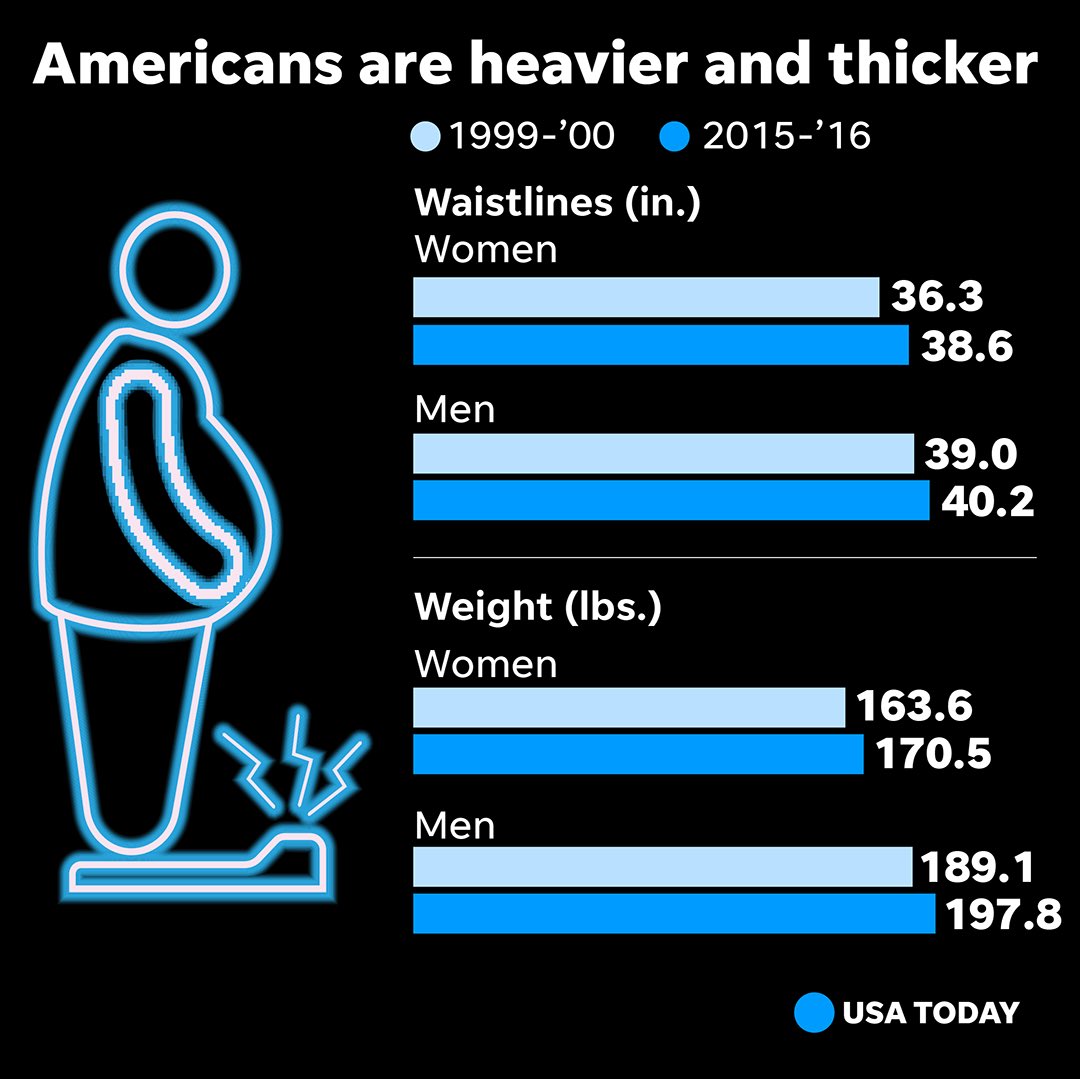
Americans have gotten heavier and thicker in the 21st century, with the numbers on the scale going up for men and women of all ages, according to a new federal report released Thursday.
Waistlines have ballooned, too, the National Center for Health Statistics said. In general, women’s waists grew more than 2 inches, from 36.3 in 1999-2000 to 38.6 inches in 2015-16. By comparison, men's middles increased just over an inch, from 39.0 to 40.2 inches during the same period.
The new report offers hard data for a phenomenon plainly visible on city streets, schoolyards and workplaces: In the past 30 years, obesity has risen to epidemic levels in the United States, but the nation still hasn’t been able to correct the problem. Being overweight can contribute to a cascade of other health problems, including diabetes, heart disease and cancer.
Dana Duffie of Orlando learned that first hand. She had been comforting herself with food since she was little and then wound up with Type II diabetes after her daughter developed cancer in the 1990s. After her daughter died at 16 in 2002, stress eating became an even bigger problem. She hopes talking about it will encourage her to address it.
"My father was an alcoholic, and as an adult I had a light-bulb moment when I realized I had learned some unhealthy things from watching him: I was hiding empty family-size candy bags or empty Little Debbie boxes or even the wrapper of that second sub that was supposed to be tomorrow's lunch, all went underneath the other trash in the kitchen trash can after everyone else went to bed.," says Duffie  "It's what got me where I am today, which is insulin dependent."
The report was based on data gathered through the National Health and Nutrition Examination Survey, which looked at weight, height, waist circumference and body-mass index in about 45,000 Americans 20 and older.


“It’s what your grandma would have told you, and hearing it from a professor now is no less important,” said Dr. Shailendra Patel, chairman of the division of endocrinology, diabetes and metabolism at the University of Cincinnati College of Medicine. “You need a varied diet, a balanced diet, with smaller portions. Your plate should look colorful, and you need to be exercising at least three times a week.”
Christine Rufkahr of St. Louis is just trying to do her own version of that, in a transition she describes as going from a "junk food vegan diet to a whole food plant-based diet." This diet has no meat, eggs or dairy but also eliminates most processed foods, added sugars or sweeteners and fats including olive oil.
Rufkahr believes many, like herself, "self medicate" for her mental health which wouldn't happen "if people had access to effective treatment." 


The waistline news is particularly grim for women.

A March study in the Journal of the American Heart Association, the women who carried more weight around their middles had a 10% to 20% greater risk of heart attack than women who were just heavier over all. This weight was measured by waist circumference, waist-to-hip ratio, or waist-to-height ratio. The study involved about 500,000 people (55% of them women), aged 40 to 69, in the United Kingdom. The researchers took body measurements of the participants and then kept track of who had heart attacks over the next seven years.


The analysis showed that compared with body mass index (BMI) - a calculation of weight in relation to height - a waist-to-hip ratio was 18 percent stronger as a heart attack predictor in women compared to 6 percent stronger in men.

Roland Whitsell, a former business school professor in Gallatin, Tenn., says excess weight crept up on him over the years as he would gain when he was experiencing depression but wouldn't lose it when he wasn't depressed. He says he's 5'10" and weighed 233 pounds when he retired 10 years ago at age 70. He says he has finally lost 20 pounds by increasing both his protein intake and his exercise, especially through backpacking, which he took up a couple years after his retirement. 

He's even still hoping to hike the Pacific Crest Trail in 2021. His last attempt got cut short. 


"I learn something each time that makes me better at backpacking," he says. "I am getting in better shape and working to have a lighter base weight."

Whitsell has also lost at least a half inch since he got out of the Army in 1956. That's in line with what middle-aged men lost in height since 1999. 

Dr. Malti Vij of the University of Cincinnati Health Weight Loss Center in West Chester, Ohio said studies such as Thursday’s present the overall bad news about the nation’s weight problem. But “these kinds of surveys are helpful at least when they are dividing by race and by age group and gender. They tell us where to focus our efforts. Looking at the data, it looks like we have to focus everywhere.”


Image result for mri obese and athlete